This year’s wildlife-themed Christmas cake celebrates one of the best birds that I saw in 2025, the Siberian Thrush on Mainland Shetland. Made of clay and painted in acrylic, the bird turned out a little more blue than I had intended, but I think it still works as cake decoration:
Check out those undertail coverts!
Footprints.
I had intended to use real holly leaves and berries from our garden to decorate the cake, but fortunately I checked their toxicity first. I discovered that all parts of the holly plant, stem, leaves and berries, are toxic to humans. A lucky escape for my family!
Below, the real thing, photographed at Loch Asta with Ben Sheldon, as we travelled back from Fair Isle, a fantastic experience:
I first visited Fair Isle in 1986 as a seventeen-year-old, benefitting from a Richard Richardson bursary to cover the accommodation costs at the bird observatory. As an inexperienced inland birder, it was fantastic to see Yellow-browed Warblers, Red-backed Shrikes and Short-toed Larks in real life, not just on the page of a field guide or a bird report. Thirty-nine years later, with a new bird observatory just completed and with a handful of autumn trips to Shetland under my belt, the time felt right to return to the “Magic Island”. With my usual travelling companion Andy Last wanting a change from birding Shetland this autumn, I spoke to Ben Sheldon, who not having visited Shetland before, was immediately keen. We booked to visit Fair Isle from September 24th to October 2nd, staying at the new observatory.
The northern end of Fair Isle, from the air. Even from this height, the shelter offered to migrant birds crossing the North Sea by the cliffs and steep-sided geos on the island is apparent.The new, luxurious Fair Isle Bird Observatory.The lounge at the Obs. The ship “Good Shepherd IV” is in dry dock in North Haven and is visible in the centre of the picture.
The Observatory garden has decent amounts of cover and contained the most confiding Barred Warbler that we have ever seen for the first three days of our stay:
One of the novelties of Fair Isle is the Fulmars that that sweep down the roads of the island and rise on updrafts of air from the dry-stone walls of the island:
Seeing Fulmars coming straight down the road towards us at eye-level, brought me straight back to seeing these birds here on my first visit to Fair Isle.
We joined the pre-breakfast trap round each day. This superb adult male Red-backed Shrike was caught at dawn on Saturday 27th September, and was the first indication that a fresh wave of birds had made landfall on the island.
A Water Rail was another unexpected find in the Gully trap one morning, giving Ben the opportunity to ring this bird on Fair Isle:
SeekingStill Air
So much of birding is determined by the movements of air. Winds both propel and displace migrating birds. Whilst inherited genetic mechanisms may determine the direction and length of a bird’s migration, moving air, clouds and rain can also affect the route taken and are often the final factor in grounding birds, especially on coastal and island locations.
But whilst moving air is a huge influence on bird migration, we reflected that birders seeking out rare birds need to look for the opposite: they need to find still air. Still air is where the migrant birds are, once they have been delivered by moving air.
On Fair Isle, our days began by trying to guess where recently arrived birds might be found. The weather on our trip was dominated by blue skies and south-easterly winds for the first half of our stay, becoming strong southerly winds with rain and cloud later. We observed that later in the week the gardens and crofts at the south end of the island, usually such a reliable area for holding migrant birds, were being battered by the southerly winds and were often less productive.
Still air trumps habitat
In southerly winds, we tried heading north, to search the ravines and geos of the sheltered coast, where birds could be seen trying to find insects on the huge sea cliffs of Fair Isle. This would often involve sitting on cliff edges and looking down. A long way down:
Milen’s Houllan, with the Gannetries of Inner Stack and Outer Stack just off the north coast. Inner and Outer Stack, viewed from Wester Lother
These cliffs are not the natural habitat of Goldcrests, Yellow-browed Warblers or Redstarts. But there the air was still. On windy days, anywhere that held still air became a potential migrant bird trap. On exposed Fair Isle, even ditches offer some respite from the wind and may hold birds. This was memorably summed up by Oxfordshire’s very own Luke Marriner, now in his second season as an Assistant Warden on Fair Isle, who looked at the wind speed forecasts and said “if there is a good bird today, it’ll be in a ditch”.
We realised that to find birds here we had to put aside our assumptions about the habitat preferences of migratory birds, or simply checking bushes just because they were there, but instead see the island in terms of moving air and still air, and seek out the still air.
Red-brested Flycatcher in South Raeva geo. Ben checking out South Raeva geo.A cliff-face Goldcrest. A clifftop Yellow-browed Warbler.
Migrant birds seeking the shelter of cliffs brings them into contact with some of the more usual residents of Fair Isle’s seacliffs. The recording below captures calling Goldcrests and Fulmars, an unlikely species combination in most parts of the world (volume up!):
Down the rabbit hole
Luke Marriner also provided the most memorable phone message of the week. Ben and I were walking the ditches of Suka Mire in central Fair Isle, when Luke’s message arrived “There is a Corncrake in a rabbit hole at North Light!” Luke had flushed the bird from virtually underfoot during his census walk around the lighthouse and it had flown before running into a rabbit hole at the top of the cliffs at Lericum. We walked up and over Ward Hill, then down past Easter Lother Water to see if we could see it. After a little searching, Ben looked down at a different rabbit hole, only to see the Corncrake staring back at him, almost within touching distance. It shot out of the hole and flew out over the sea, to land half-way up the enormous sea cliffs here, a surreal location for a crake. Migratory birds have to adapt to the environments they find themselves in. Anywhere with shelter from the wind offers some form of safety.
Cliff-bound Corncrake! Ben (left) and Steve Arlow scan the cliffs for the Corncrake.
Migrants
Strong southerly and south-easterly winds are not great for goose and swan migration, but a few Barnacle, Greylag and Pink-Feet made it to the island during our stay. These migrating Barnacle Geese looked and sounded fantastic:
The croft gardens of Lower Stoneybrek, Stackhoull, Vaila’s Trees, Schoolton and Quoy were our most productive sites in the south of the island. I was admiring this Common Rosefinch at Schoolton…
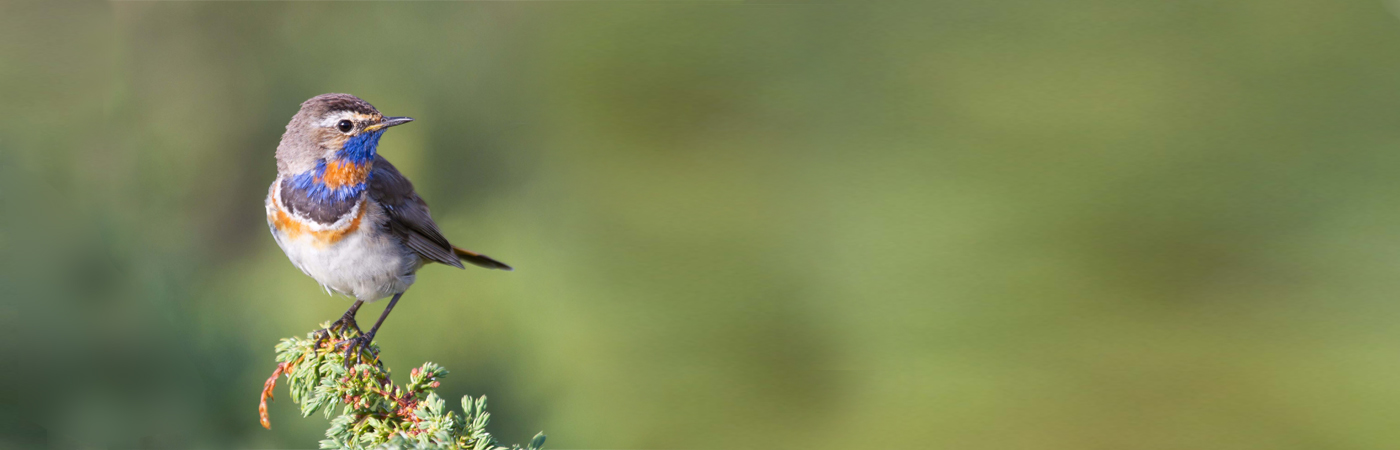
… when a Bluethroat flew in and gave astounding views as it hopped around the garden:
This female Hawfinch was seen most days, briefly appearing at Schoolton, but we also had good looks at Burkle:
A likely continental Great Spotted Woodpecker, seeking trees. Ben on Ward Hill
We found a freshly arrived Barred Warbler at Vaila’s Trees (“trees” is a relative term on Shetland, think a few dwarf pines and shrubs in a small walled garden, with nothing over 1.5 metres tall) that popped up in front of me and starred me down with those intense eyes, before lumbering off back into cover.
In island terms, the rarest bird that we saw during our stay was Fair Isle’s fifth-ever Glossy Ibis. Part of large influx of birds into the UK, this bird continued northwards and was seen on Mainland Shetland later the same day. Where next?
Fair Isle’s fifth-ever Glossy Ibis fles north down the island.
Later in the week, the weather deteriorated, bringing southerly gales, cloud and rain. We did a spot of seawatching during one storm with fellow guests Phil Woollen and Jason, and picked out a couple of Sooty Shearwaters and Red-throated Divers fighting their way south.
Ben, Phil and Jason seawatching at Buness. Sooty Shearwater south past Buness
“Schreep” behind the sheep
The weather was now playing havoc with our travel plans. On 2nd October we were due to fly back to Mainland Shetland, but low cloud hanging over Tingwall airfield meant that the small inter-island plane never left Mainland. We would be stuck on Fair Isle for at least another day, and with the super intense low of Storm Amy moving huge amounts of air as she approached from the west, our concern was that we would be stuck on the island for days. I was trying to rearrange our travel plans by phone when I flushed a large pipit that gave a loud “schreep” call. It flew a short distance and landed in the grass behind a nearby sheep. I called to Ben, “Richard’s Pipit behind the sheep!” and we enjoyed decent views of the bird feeding in the grass, just west of Shirva:
Richard’s Pipit, sheep. Richard’s Pipit, schreep.
Dipping Dunnock
Ben is a very sharp birder. So much so, that he had managed to glimpse three species during our trip that I had yet to see as we entered our final planned day on the island: Peregrine, Blackbird and Dunnock. During the day, I pulled back Blackbird, as a few new birds arrived on the island. As dusk began to fall, we were passing Chalet on our way back to the Observatory, when a small dark passerine dived into the cover of the bushes in the garden. Panic stations, it was a possible Dunnock!
Keen to level up our trip lists, I took a step along the path through the garden and immediately flushed a pipit that called with a high-pitched call and then dived straight back into the shrubbery of the garden a few meters away. Ben and I looked at each other, we both instantly knew that this was a good bird. The call was not quite right for Tree Pipit and neither was its behaviour. The challenge was that this was a very difficult bird to see. In the remaining light, we only had four flight views, which produced no photos, and heard two flight calls, neither of which I managed to record due to wind noise. We returned to the Observatory with mere news of a “mystery pipit” at Chalet. Privately, our hunch was that this bird was not behaving like any Tree Pipit that we had ever encountered and the call sounded good for Olive-backed Pipit, but we had no recording.
With the weather clearing the next morning, we only had an hour before the plane was due to take us back to Mainland and it was a twenty minute walk each way to Chalet. Time was against us. But as we walked quickly down the main road towards Chalet, the mystery pipit rose from the sheltered side of the house and called again, before diving back into cover. The bird was still here, was still very elusive, but in better light did perch very briefly on the road allowing a few poor photos to be taken. I also managed to record a single flight call, whilst sheltering in the still air provided by the garden bushes. Sadly, there was no further sign of the Dunnock.
There was no time to process our pictures, we were on the plane back to Mainland Shetland within the hour, but our back of camera previews revealed a pipit with a smooth unstreaked mantle and a head pattern that looked good for Olive-backed Pipit. The bird’s identity was completely resolved an hour later when Fair Isle warden Alex Penn managed to get a decent picture of the pipit, which confirmed that it was indeed a fine Olive-backed Pipit. We would take that! The Olive-backed Pipit remained on the island for that day, but remained very elusive, hardly showing for more than a few moments at any one time. By this date, this was only the second Olive-backed Pipit seen in the UK this autumn, despite many birds being recorded in Scandinavia this year:
Despite the fact that I still needed Dunnock, we left Fair Isle feeling satisfied. It is a beautiful island with spectacular coastal scenery. We had covered over 160km/100 miles on foot in eight days and found a nice selection of scarce migrants, including Barred Warbler, Richard’s Pipit and Olive-backed Pipit. We totalled 108 species between the two of us, making it the most productive of the six autumn trips to Shetland that I have made, and we were on a single island for most of the trip. Only one thing was missing. A monster Shetland rarity.
From geos to geokichla
Now we were a full 24 hours behind our scheduled return. We had a rather bumpy plane journey back to Mainland, but Storm Amy was about to interfere further. Flights back to the Scottish mainland were being cancelled rapidly. We resigned ourselves to spending one, possibly two, nights on Mainland Shetland sitting out the worst of the storm, before travelling back on Sunday (a whole three days late) when the winds were due to reduce in intensity. Storm Amy was predicted to hit Mainland Shetland at 5pm on Friday, when the winds would pick up to 105kph/65mph and the first bands of intense rain would arrive. We had about three hours of possible birding time. It was Siberian Thrush time.
To date, the standout rarity of this autumn was the arrival of a first-winter male Siberian Thrush on Mainland. This is one of the ultimate Shetland rarities, a stunning bird, full of plumage features, as well as being supremely rare (about 12 previous UK records) and very, very elusive. The bird’s Latin name of geokichla sibirica literally translates as “Siberian ground thrush” but this bird had taken to feeding on elder berries in a small patch of trees by Loch Asta in central Mainland. This Siberian Thrush was typically good at hiding itself in the deepest clumps of leaves when it came up to the canopy to feed. With patience, glimpses of small parts of the bird could be made out, a blue wing here, a tail there, if you were lucky a glimpse of an eye or the head pattern. Some of our best views were had by standing in the loch:
In the first hour, this was my best view of the Siberian Thrush. It is the small square of blue-grey in the middle of the picture. In the second hour, things improved very slightly: the undertail coverts, tail and wing were visible here.
After two hours and no more than a few glimpses, I had nearly given up hope of getting a satisfying view of the Siberian Thrush. The skies were darkening, the wind was picking up, Storm Amy was nearly upon us. Then, like a dark shadow slipping away, an all-dark thrush flew low out of the back of the trees and crossed the road into the garden of the house by the loch. Optimistically, we peered over the wall of the garden, dreaming of seeing this mythical thrush feeding out in the open. And suddenly there it was. At first, it was feeding behind a plant pot, partially hidden. And then, casual as a Blackbird, it simply hopped out into an open area beneath the trees in the garden:
The blue! The head pattern!! The undertail coverts!!! We drank in dream views of the Siberian Thrush for perhaps 60 seconds, before it hopped away, out of sight again. Sometimes one minute can seem like eternity. And then the elation hit.
We ended the night staying at the Sumburgh Hotel, celebrating seeing one of the best birds, which provided an epic finale to a great trip, even if we were three days late getting home.
Our entire trip list, with all species recorded, photos and sound recordings, can be seen here.
August is a great month on my local patch. The focus during the second half of the month is on recording the locally scarce trio of Western Yellow Wagtail, Spotted Flycatcher and Tree Pipit. The wagtail and the flycatcher have been annual in very small numbers for the last seven years, but Tree Pipits are much harder to connect with. Tree Pipits have been recorded on average about once every other year in the Lye Valley area, although the last record was 28th August 2022, with 2023 and 2024 both being blank years.
My experience is that I hear Tree Pipits migrating overhead in periods of high pressure: nice sunny mornings, with either no wind or just a gentle south-westerly breeze. I don’t usually record them at very first light, which can be before 5:30am in mid-August, but often between 7am and 9am. This leads me to think that the birds that pass over this part of east Oxford have roosted elsewhere, and then have begun their migration at dawn, passing over me an hour or two later. There have been a couple of records of grounded birds, but the majority of records involve migrating birds, flying over, calling.
All the records of Tree Pipit in the Lye Valley area have been between August 21st and September 8th:
This year Mark Merritt found the first autumn Tree Pipit on the Oxfordshire downs on 8th August, his earliest by nearly two weeks. On 9th August another bird was reported over Cutteslowe Park in north Oxford by Jeremy Dexter. The forecast for this morning, 10th August, was perfect: high pressure with virtually no wind. I was out at dawn, but returned from the Lye Valley area with nothing more than the first autumn Willow Warbler for my efforts. There was no visible overhead migration at all.
At 8am, I was sat at the kithcen table, with the windows open, when I head the explosive, buzzy squeak of a Tree Pipit passing overhead. I ran outside, pressed “record” on Merlin on my phone and fortunately the bird called twice more as it headed south-west:
An unbelievable garden tick, which continues a fabulous summer for the garden list after recording a Mediterranean Gull over the house last month!
Of course, the challenge still remains to add Tree Pipit to the Lye Valley area year list. This morning, I was probably out a little too early. The forecast looks ideal for Tree Pipit migration over the next week, and with Mark finding another two birds today and a further Tree Pipit being reported over Otmoor this morning by Peerawat Chiaranunt, the early signs are that we are in for a good Tree Pipit year, especially as we have not reached the peak period for migrant birds of late August. Listen for the flight calls and watch this space!
Iberian endemics in the forests of north-east Portugal
One of the great things about visiting old friends in Portugal was the opportunity to experience inland rural Iberia. Their house in north-east Portugal was tucked away between the hilltop city of Guarda and the border with Spain. Tiny near-deserted villages, small fields and stone walls stood between fragments of the vast oak and chestnut forests that would have originally covered this landscape.
I visited the Freixal river valley at dawn on three mornings. It produced some of my most enjoyable European birding. This area, at nearly 1000m above sea level, was pleasantly cool at dawn, but fiercely hot by the afternoon. The oak woods were full of singing Western Bonelli’s Warblers, fluting Golden Orioles and yaffling Iberian Green Woodpeckers. Dartford and Sardinian Warblers were common, Woodchat and Iberian Grey Shrikes patrolled the fence posts. I was in heaven!
The soundscape was magnificent:
Below are some recordings and photos of the birds of this area of north-east Portugal. First, an Iberian Green Woodpecker, competing with a calling Western Bonelli’s Warbler and a singing Iberian Chiffchaff:
Iberian Chiffchaff calls, slightly reminiscent of Common Reed Bunting calls to my ear:
Iberian Grey Shrike, always distant:
Iberian Grey Shrike
Other noteworthy non-endemic birds included Western Bonelli’s Warbler, the commonest warbler here, its trilling song constantly ringing out:
Western Bonelli’s Warbler
Golden Orioles were everywhere, and incredibly vocal, both calling and singing:
Golden Orioles
Witness the amazing trilling song of Spotless Starling!
One of the noisiest birds in the woods, Iberian Magpie, here with a burst of Spotless Starling at 0:22 into the recording:
Iberian Magpie
It was rewarding to see European Turtle Doves, now close to extinction in the UK, but there were still birds in central Portugal. This is a fast-flying species, so I was pleased to get flight shots of this bird as it flashed through:
European Turtle Dove
Woodchat Shrikes had bred successfully nearby:
Juvenile Woodchat Shrike
It is always great to see Eurasian Hoopoe, they were recorded daily, but were typically shy:
Eurasian Hoopoe
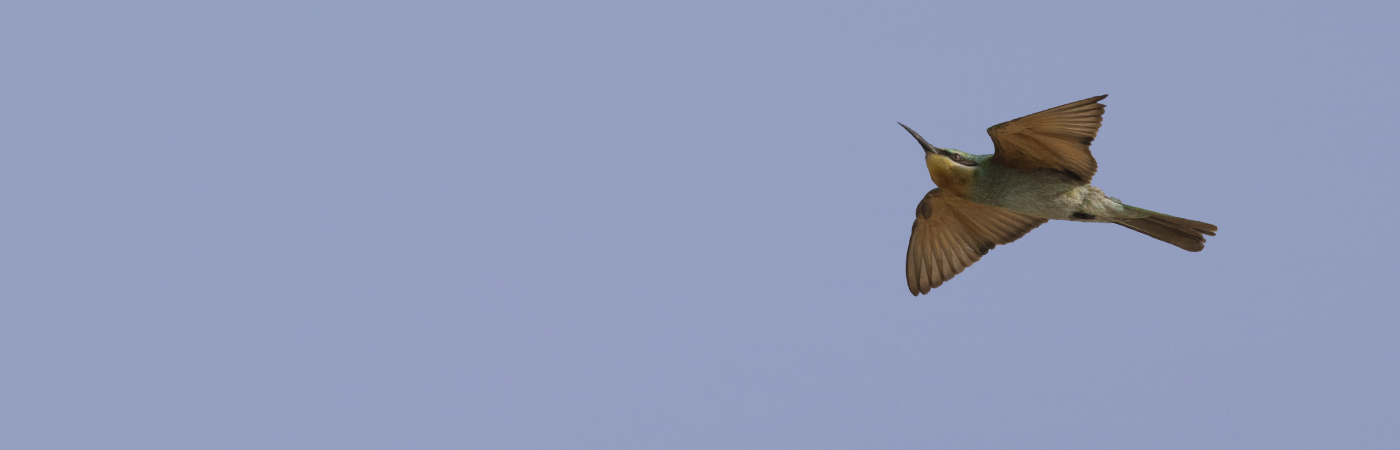
European Bee-eaters were very regular flyovers, some hawked for insects, but most passed overhead to feed elsewhere:
European Bee-eater
Dartford Warbler outnumbered Sardinian Warbler here, I also recorded a single Western Subalpine Warbler.
Dartford Warbler
The drier, more open areas held Rock Sparrows, whose two-tone nasal calls were distinctive:
Rock Sparrow
A typically secretive Cirl Bunting, slipping away into the oak leaves:
Male Cirl Bunting
So this was where all those Woodpigeons and Chaffinches go every autumn. I could see why; I could come here every year.
With the heat continuing and Warneford and Churchill Meadows on my local patch gradually turning to straw, urban east Oxford felt more like the Mediterranean this week:
And then the Mediterranean came to me. I was packing the car to depart for a family celebration in Suffolk, when I was thrown into complete chaos as I heard the repeated “yee-ow, yee-ow” calls of a Mediterranean Gull approaching from the south! It flew overhead at a medium height, calling constantly. I whipped my phone out and just about managed to get a poor an atmospheric recording of the final two flight calls, before it disappeared north and away over Headington:
This is, without doubt, the best bird species yet recorded on my garden list.
In Suffolk, after the family celebration, I took my sister, her daughters and one of my daughters out onto some local heathland, where we experienced the amazing, evocative sound of churring Eurasian Nightjars:
Here I also managed to make apoor an atmospheric recording of two species that share the same habitat, but are not always heard singing together, Tree Pipit and Eurasian Nightjar:
Then back to see what the moth trap had produced in rural Suffolk. Highlights were a Small Elephant Hawk Moth, this huge Oak Eggar and a nice Dusky Sallow:
Oak Eggar mothDusky Sallow moth
A memorable day with a fantastic Mediterranean theme!
With a national influx of Common Crossbills taking place this summer, any conscientious local patch birder should be out searching for Crossbills, their flight calls fresh in the mind from revision sessions on Xeno-Canto or the Macaulay Library. Whilst this influx had caused me to remind myself of the flight calls, I was far from being on full alert on Monday morning. There were two reasons for this. Firstly, my camera broke last week, frustratingly as I left the house to see and hear Oxfordshire’s second Savi’s Warbler, and is currently being repaired.
Secondly, the birding year has entered the Dead Zone. In birding terms, mid-May to late July are deathly quiet in the Lye Valley, Oxford. Resident breeding species are feeding fledged young, there are Swifts overhead, but very little else. The last seven years have demonstrated that adding new species to the Lye Valley year list is near impossible in these ten weeks of early and mid-summer.
This combination of factors meant that on Monday morning I visited my local patch without a camera or a microphone. Of nearly 800 patch visits, this was one of a tiny handful when I left the house with just binoculars. With hindsight, I should have known that this would guarantee that a good bird would fly over.
As anticipated, the visit was completely uneventful until I left Churchill Meadow, adjacent to the Churchill Hospital. Suddenly, the sky was filled with loud “chip-chip-chip” flight calls from directly above me, and immediately the thought “Crossbills?” flashed through my mind. I picked up the source of the calls, a flock of four large finches, flying quite low, on a line from the Lye Valley towards Warneford Meadow, over the southern edge of the hospital. The binocular views were really good, and I could see the huge bill on the closest bird: they were CommonCrossbills! The birds appeared to be pretty uniform against the sky, with no white or colour visible in the wings or tail. The flock continued west and out of sight, those distinctive flight calls ringing out constantly.
I stood staring after the flock in a mild state of shock. As someone who has been meticulous in evidencing bird records with photos or recordings, it was slightly frustrating to have a locally rare bird flyover and not be able to capture the flight calls in a recording. But strangely, not having to grab a camera or point a microphone at disappearing birds in flight made this one of the more relaxed flyover experiences: I just watched and listened to the flock going over and enjoyed every second.
The flight calls sounded like this, especially the calls in the second half of this recording…
… calls that I’ll be listening out for in the next couple of months, though hopefully next time I’ll have working recording gear with me.
This is the second patch record of Common Crossbill, after two flyover birds in September 2020. This record takes the 2025 Lye Valley year list to 69 species, two species of which have been seen by others (Reed Bunting and Little Egret). The complete Lye Valley illustrated bird list can be found here.
Our final days on the MSC Musica are spent sailing north, towards South Africa, leaving the albatrosses and prions behind. Some 5 million pairs of Salvin’s Prion breed on Prince Edward Islands and Crozet, with 2,000 pairs of Fairy Prions breeding across both Prince Edward Islands. Prions were abundant in the waters around Marion, at times thousands per hour passed the ship:
The prion swarm
Prion identification is notoriously difficult. Like the identification of wandering-type albatrosses, birds around known breeding islands are all assumed to be the species that breeds on that island. Away from the breeding islands, such a strategy breaks down. And like the great albatrosses, prions do range widely at sea, in the non-breeding seasons.
Pragmatically, we were told to assume that most prions we saw would be Salvin’s Prions, with smaller numbers of the dark-tailed, paler Fairy Prions present too. The challenge of prion identification is the huge variation between birds of apparently the same species. We thought that we may have photographed a strong candidate for the more uncommon Broad-billed Prion:
This bird has a large bill, a very steep forehead and a long wavy moustache, reaching back from the gape line to join the dark ear coverts.
Compared to the average Salvin’s Prions that we saw in great numbers, we thought that our bird stood out. Compare the head-shape, moustache and bill size to this typical Salvin’s Prion, for example:
Salvin’s Prion
But the expert consensus was that our bird had just too much blue on the bill. Ideally, Broad-billed Prions have all black bills, making our bird a large-billed, long-moustached Salvin’s Prion, depsite it’s very different appearance.
Cetaceans and seals
This presumed Subantarctic Fur Seal popped up near the ship as we left the waters near Marion. Despite facing extinction due to hunting by the whaling industry, both Antarctic and Subantarctic Fur Seals are recovering in numbers:
A large number of cetaceans were seen from the ship, but were usually distant. Overall, we tended to prioritise the passing birds. Whale blows were seen very regularly, on one occasion a Sei Whale was photographed close to the ship and a number of beaked whale species were identified. A fabulous black-and-white Hourglass Dolphin playing under the bow for a few seconds was a personal highlight.
As we travelled north, we passed over the Subtropical Convergence once more and, as if by magic, we were back into Great-winged Petrel territory, with few other seabirds, other than Tropical and Cory’s Shearwaters, being seen.
We docked in Durban early on 31st January, waking up to the hot, humid conditions of southern Africa. Birdlife South Africa arranged a group photograph of most of the birders on the top deck on the final afternoon:
It was heartening to hear that Flock to Marion Again had raised over $US250,000 for the Mouse-free Marion Project. To date, about a quarter of the US$30M required to complete the mouse eradication project on Marion Island has been raised, so there is still some way to go. Donations to save the fabulous seabirds of the Southern Oceans can be made here!
The eBird trip list of all the species recorded on Flock to Marion Again (plus a few around the hotel on the first morning) can be found here.
We awoke off the west side of Marion Island, everyone up at 4am for another seabird spectacle. Dawn did not produce the huge numbers of feeding seabirds that we saw yesterday morning, but the quality of the birds was undeniable:
Indian Yellow-nosed AlbatrossLight-mantled Albatross
Everyone’s favourite mollymawk, the fabulous Grey-headed Albatross:
Pterodroma Tuesday
We had seen many Soft-plumaged Petrels as we approached Marion, even though this species always kept some distance from the ship. It was educational to see these Softies, as the South Africans call them, having seen the closely related Desertas and Zino’s Petrels off Madeira:
Soft-plumaged Petrel
The challenge of identifying dark pterodroma petrels in these waters is compounded by the presence of the occasional dark morph Soft-plumaged Petrel. We saw half a dozen of these birds during our time around Marion, though they only make a tiny fraction of all Softies:
More than once these dak-morph birds were misidentified as Kerguelen Petrels, a rare local breeder, which we did not see. The announcement of a possible Kerguelen Petrel caused panic amongst the birders on the ship. Everyone on the ship’s opposite side would try to cross the ship to see if they could catch up with the passing bird in question. On a ship of this size, this was nearly impossible. If you didn’t choose your door carefully, you ended up running through a casino, bar or restaurant. Both pale and dark morph Softies are in this picture:
Two shades of Softie.
Picking out interesting petrels from the constant mass of flying prions around the islands was not easy. Andy did well to call this Blue Petrel as it passed down the side of the ship. The white tail tip is distinctive, and they have a slightly more dark-capped appearance than prions:
But there are enough similarities to prions to make picking one out from the prion swarm a good call:
Left, Salvin’s Prion; right, Blue Petrel
One of the highlights of the trip for many were the small number of White-headed Petrels that we saw in Marion waters. Ian called out the first bird, the white head and tail, contrasting with the near black underwing, make this a stunning pterodroma to see:
There was drama mid-morning, when a White-headed Petrel and two Grey Petrels, the only ones of the trip, were found together off the port bow:
Grey Petrel (photo by Andy Last).
By 11am, it was time to begin our two and a half-day journey back to port. The ship, having been cruising as slow as 13kph during our time around the islands, increased its speed back up to over 30kph and we turned towards Durban.
We were sailing down the south-east side of Marion Island at a distance of about 20km, when the shout of “penguin in the water!” began to be heard (although now I reflect back, where else would a penguin be?). Four species of penguin breed on the island, but getting good views of penguins in the sea is the opposite of visiting a breeding colony. As soon as the penguins saw the ship, they bounded away, like mini-dolphins, disappearing into the waves. Most of the time the penguins were underwater, and in the majority of cases only the finder would see the disappearing birds. They were simply too quick for other observers to see them before they disappeared underwater.
Macaroni Penguin
In the first two hours of daylight, I failed to see a single penguin, despite multiple birds being called from all around me. As the day wore on, I either got my eye in, or the penguins were more cooperative, as most of us managed to see something of the small flocks of penguins feeding in the sea around the islands.
Macaroni PenguinsKing Penguins
Macaroni Penguins were by far the most common, with smaller numbers of the iconic King Penguin being seen. A real surprise occurred when a Gentoo Penguin popped up close to the ship, where Andy and I were standing on deck 7. Only about 1,500 pairs of Gentoo breed on the islands and they are inshore feeders, so this was an unexcepted treat. For context, there are 225,000 pairs of King Penguin and 270,000 pairs of Macaroni Penguin breeding on the Prince Edward Islands.
Gentoo Penguin
Petrel Pleasure
Another unexcepted surprise was a flypast by a Pintado Petrel. We were told that only four pairs breed on Marion Island, so this bird created some real excitement for the South African birders.
Storm petrels were near constant companions to the ship all day. Grey-backed Storm Petrels feed on larvae found on the patches of kelp that floated past. These tiny seabirds, with a wingspan of only 40cm, were the smallest birds that we saw on the trip:
I never tired of seeing Black-bellied Storm Petrels:
Another small bird that we encountered frequently was Common Diving Petrel. Just slightly larger than a Little Auk, these birds zipped along, just above the waves, often diving directly into the water. 10,000 pairs breed on the Prince Edward Islands, benefitting from the eradication of cats on the island, which was completed by 1991, but still at risk from the seabird-eating house mice that have exploded in numbers since the cat eradication.
Common Diving Petrel
What an incredible day around Marion Island: six species of albatross (Snowy, Sooty, Light-mantled, Indian Yellow-nosed, Black-browed and Grey-headed) and three species of penguin (King, Macaroni and Gentoo) made it a really special day.
Dawn on day four found us just to the east of Prince Edward Island. Today would be the main day that we would experience the seabirds of the southern oceans, with half a day planned around the west side of the islands for the following morning. The ship was very busy with birders from 4am. As the sky lightened, Andy and I went to the back of the ship and were greeted by incredible scenes. There were seabirds covering the entire sea.
Hundreds of albatrosses could be seen in a single 180-degree sweep. Both Northern and Southern Giant Petrels were everywhere, as were both Sooty and Light-mantled Sooty Albatrosses.
Five Snowy Albatrosses, an Indian Yellow-nosed Albatross (top right), together with Giant Petrels and White-chinned Petrels. There is even a tiny Black-belled Storm Petrel (wingspan 46cm) under the farthest right Snowy Albatross (wingspan up to 3.5 meters)!
The number of Snowy Albatrosses was astounding These huge birds drifted around, occasionally gathering in groups to fight over food sources:
An Indian Yellow-nosed Albatross and two White-chinned Petrels fly past a feeding group of Giant Petrels and Snowy Albatrosses. Giant Petrel is more than suitable name. Unless you are floating next to a Snowy Albatross.
But it was not just the sheer number of birds that we could see, it was the quality of some of those views. These huge seabirds would float up to the rear of the ship and pass at eye level, giving astounding views:
A Black-browed Albatross became our seventh species of albatross on the trip and one of six species that we saw in this single day.
Snowy Albatross
From the largest albatrosses to the smallest storm petrels, seabirds were around us all morning:
Grey-backed Storm Petrel
On the horizon, both Prince Edward and Marion Islands could be seen, the latter with snow coating the higher peaks, even in the middle of the austral summer. The highest point on Marion is Mascarin Peak at 1,230m high, South Africa’s only active volcano, which last erupted in 2004:
Marion Island
It was an incredible morning, one never to be forgotten, despite the sub-zero temperatures on deck all day. The sheer number of seabirds that we saw will remain long in the memory, as will the point-blank views of the albatrosses and giant petrels of the Southern Oceans.
(l-r) Ian, Andy and me.
Next: Magical Marion, part 2: Penguin Pain and Petrel Pleasure