Having experienced the dry fields of northern Mallorca, baking in another European heatwave, I visited my first wetland site on 13th July. I called in at a small site in nearby Alcúdia. As I walked through the reeds alongside the lake before dawn, I thought that I had glimpsed a Night Heron quite close to the track. A gap in the reeds provided a decent view over the lake. There wasn’t a Night Heron. There were dozens of them. Even with the naked eye, I could see that the entire lake appeared to be covered in herons and egrets. Literally hundreds and hundreds of herons and egrets, almost overwhelming numbers of herons and egrets. It was an incredible sight:
The nearest birds were Black-crowned Night Herons. Every patch of exposed mud had one perched on it:
Slightly further back, there were hordes of Purple Herons, with a smaller number of Grey Herons also present. eBird tells me that I have seen Purple Heron on 15 occasions since my first at Minsmere in 2002 (this total does not include one of my most painful Oxfordshire misses). My first scan across the waters of Maristany produced at least 25 Purple Herons, nearly doubling my lifetime sightings of these magnificent birds in just a few seconds. A count from this site later in the day totaled 48 Purple Herons, a site record count:
Egretapocalypse
Little Egrets were the commonest species; at least 160 were present, the majority feeding in a huge white mass at the back of the lake. Amongst them were Glossy Ibises and dozens of noisy Black-winged Stilts:
Above, an adult Purple Heron (top left) and a juvenile Grey Heron (centre), stand behind Glossy Ibises, Little Egrets and Black-winged Stilts.Black-winged StiltsGlossy Ibis
Below, Squacco Herons were present in much smaller numbers than the other herons and egrets, with up to 10 birds present:
The big beasts: Greater Flamingo. Always a surreal combination of pink and impossibly long legs, just fantastic to see:
Other species of note included the long-staying dark-morph Western Reef Heron and a handful of Marbled Duck:
Both adult and juvenile Gull-billed Terns were present. They were very inquisitive and vocal, coming over to investigate me as I walked down the main track:
The award for the wildest call of the day went to the bizarre trumpeting of Western Swamphen as two birds interacted at the edge of the reedbed:
Later in the week, I made a dawn visit to the observation tower at Son Bosc, in the southern part of the s’Albufera Reserve. There were a few lagoons here, next to an extensive area of reeds:
Son Bosc/Depuradora, Parc Natural de s’Albufera de Mallorca
As I waited for the sun to rise, I heard the honking of geese from behind me. Not having recorded any geese species on Mallorca, I turned around only to discover that I had heard the goose-like honking of flying Greater Flamingos. These calls are audible on this recording, although any sound recording at this site has to compete with the incessant calls of Black-winged Stilts, with both adults and recently fledged young present and vocal:
Greater Flamingo: looking better than they sound.
Warblers
The reedbeds and surrounding areas held Sardinian and Cetti’s Warblers, Common Nightingale, Zitting Cisticola and Western Yellow Wagtails. Western Marsh Harriers quartered the reedbeds and calling European Bee-eaters passed overhead.
I enjoyed spending an hour or so just watching various warbler species move through this habitat. A Subalpine Warbler-type appeared once, but was distant and frustratingly never revealed itself again, so was left unidentified. Cetti’s Warblers were common, with adults and juveniles present:
Common Reed Warblers were abundant:
At least two Great Reed Warblers also lumbered around the bushes, though always kept their distance:
Eventually, I picked out the warbler species that I most wanted to see here, Moustached Warbler:
The black crown and huge white supercilia were obvious, though very little sign of the thin black sub-moustachial stripe that gives these birds their name on this individual. From the front, Moustached Warblers are very pale birds:
Having moved through the bushes by the observation tower, one Moustached Warbler began singing. The opening series of rising notes (reminiscent of a kettle coming to the boil to my ear!) is distinctive, before they deliver bursts of scratchy acrocephalus song:
Finally, to the beach to see one of my favourite Mediterranean species, Audouin’s Gull. I deployed a chip or two, then sat back to enjoy these beautiful birds:
We stood, taking in our first views of the Puig des Fangar, the pine-covered hill that formed the backdrop to our house. The pine forests cloaked the steeper terrain. As the ground levelled off, they were replaced by deciduous trees, then agricultural fields. As the scent of warm pine forests washed over us, the calls of Common Crossbills rang out. This was going to be good.
Cleopatra Butterfly
Then something small and yellow fell from above, twisting and spinning, landing on the ground between our sandalled feet. In silence we looked down. It was the single wing of a Swallowtail butterfly. Beautiful, pristine, but completely detached. Somewhere above us, a Preying Mantis, or a bird, had just predated the butterfly and detached its wings.
There was no shortage of insects here.
Egyptian Grasshopper: huge, with amazing humbug eyes. Dawn in the fields
Insects mean birds and there was no shortage of interesting birds. Small flocks of Western Cattle Egrets fed in the fields, whilst the immediate area around our house held the ubiquitous Sardinian Warblers, Common Chaffinches, European Greenfinches, EuropeanGoldfinches, Red-legged Partridges, Common Firecrests and huge numbers of House Sparrows and Collared Doves. Even better were singing Cirl Buntings:
Common Hoopoes were a daily treat:
Local endemic subspecies included Mediterranean Spotted Flycatchers, which were recorded at every site we visited, from the coast to the mountains:
The loud calls of Spotted Flycatcher were the sound of Mallorca, we heard them everywhere:
Balearic Woodchat Shrikes were also very common; a pair with at least three juveniles were in the field next door;
Best of all were Eurasian Wrynecks, also in the field next door:
This incredible call stopped me in my tracks. Sounding almost like a locustella warbler, this is the begging call of a juvenile Eurasian Wryneck (volume up):
Flyover birds included Pallid Swift, Yellow-legged Gull, Red Kite, European Serin and this fabulous Black Vulture:
At night the quality continued, with Common Nightingales whistling and croaking; distant Eurasian Nightjars churring and Stone Curlews calling from all around us. On our final night, a Eurasian Nightjar made a memorable close pass right over our house. In the early hours, a distant Eurasian Scops Owl could be heard hooting metronomically. Below, the sound of hot nights (the temperature never went below 29°) Stone Curlews and the constant roar of cicadas:
I arrived at the Barrage de la Grand Dixence at 7:15am. The group of teenagers I was chaperoning had been up past 2am last night and would be asleep until mid-morning. It was time to try to find a Wallcreeper.
Barrage de la Grand Dixence
Wallcreeper is one of the best birds in the world, and for me, probably THE best. Only found on vertical cliffs in the highest mountains, this bird, in summer at least, is only seen surrounded by stunning mountain scenery. The bird itself is a delight. Superficially appearing grey and black, well camouflaged against a rock face, Wallcreepers flick open their wings as they move about their vertical habitat. The black wings have two large white spots on each primary, and each primary base and all the wing coverts are the colour of deepest crimson. The effect of this palette is sudden flashes of black, white and crimson, a stunning combination from this jaw-dropping jewel of the high mountains. But, as always with this species, first there was the task of getting into their high altitude breeding territory, and secondly, there was the challenge of actually finding one. Wallcreepers have large territories and are not straightforward to see.
The Barrage de la Grand Dixence is the world’s tallest dam, some 285m high, with the crest standing at 2,365m, high enough to give access to the birds of the high Alps. The easy way up is to take a cable car, but this does not start until 10am. There is also a winding access track that allows the authorities to drive vehicles up to the top of the dam; you can hike up this track anytime. Or, you can take the steep path, which runs pretty much directly up the side of the mountain, alongside the enormous dam wall, which holds back some 400 million cubic meters (approximately 10.6 billion gallons) of water. Best not to think about that. I took the steep path. It is a lung-busting climb, but it only takes about 20 minutes. The trees on the lower slopes held the ubiquitous Black Redstarts and singing Eurasian Blackcaps, Redpolls, Common Chiffchaffs, Common Linnets and a singing Lesser Whitethroat. I also noted a singing Dunnock. I was hoping that this would not be the only species of accentor recorded today.
Code Crimson
As the steep path flattened out it met the top of the access road, and I found myself just below the cable car top-station:
Top cable car station at the Barrage de la Grand Dixence
The view, back down to the car park and over the valley, was incredible. Even above my hyperventilation, I could hear a singing Alpine Accentor and a flash of white nearby drew my attention to a White-winged Snowfinch, feeding on the ground, it’s beak full with insects:
I did not consciously recall seeing a movement in my peripheral vision, but something made me look up, away from the Snowfinch. There were two grey and black triangles on the wall above me:
As I became aware of them, I simultaneously became aware of pulses of black, white and crimson as the birds moved. There were two Wallcreepers feeding on the concrete wall above me. Holy Jesus!
This was beyond my wildest dreams. I had found only one report of Wallcreeper at this site this month, though a pair had been regularly reported in previous breeding seasons, once even nesting in the wall of the hotel at the bottom of the dam. I was far from certain that I would see them today. Yet, here they were, almost immediately and at close range and in perfect light.
Moving slightly closer to the wall, I could see that the regular wing-flicking created some pretty funky shapes:
The Wallcreepers moved with short hops, somehow gaining traction on what appeared to be a near-flat, vertical wall. Occasionally, they took jumps to traverse the rock face. Below, both legs are visible as this Wallcreeper ran across the rockface, using its wings to help propel the movement:
One bird made a short flight by literally hopping from the rockface, its legs in the process of being retracted, leaving its rapidly shrinking shadow on the rock wall:
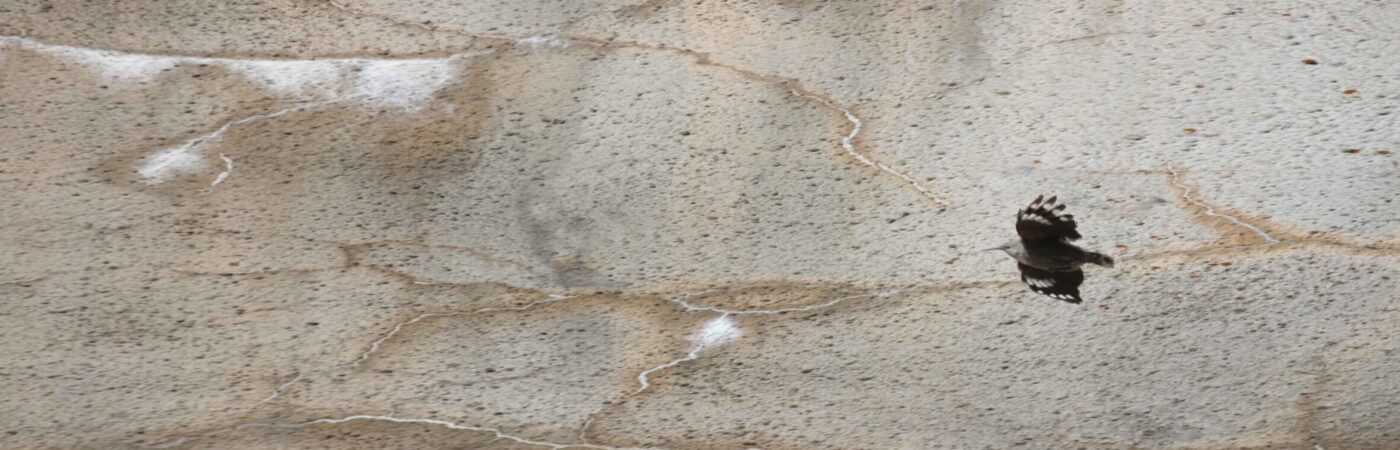
The French refer to Wallcreeper as the “butterfly bird” of the mountains. The rounded wings with black-and-white flight feathers are immediately reminiscent of Eurasian Hoopoe. But when seen in flight, and unlike Eurasian Hoopoes, Wallcreepers appear very short-tailed, creating a diagnostic flight image:
Without warning, one Wallcreeper left the wall and flew over my head and rapidly away, staying close to the cliffs to the north. The Birding Gods then looked down at me and granted me some fortune. The remaining Wallcreeper dropped down to the base of the wall, even closer to me and now at head height. It then began to work its way up the rock face, Treecreeper-style. This bird gave fabulous views, revealing the crimson at the base of the wings at close range, the soul of any Wallcreeper encounter.
Below: when stationary, the crimson primary bases and wing coverts create two bright bars of colour on the black closed wing:
As the wings flick open, the extent of the crimson primary bases becomes apparent. The double white wing spots on the outer four primaries flash. The effect is astonishing!
Having moved up the wall a short distance, the female Wallcreeper then took the same flight path as its mate, over my head and away to the north, rounding a corner of the cliff and flying out of sight. The whole encounter lasted a little over two minutes, but I was left reeling from the adrenaline of the experience. Realising that I had been incredibly lucky to come across two Wallcreepers at close range so quickly, I took the path that runs south along the west side of the reservoir to find some more birds.
Lac des Dix and the pathway running along the west shore of the reservoir.
Taking the path around the reservoir involved going through a number of tunnels. This was much easier on my return journey, by which time the tunnel lights had been turned on! On my outward walk, I passed through these tunnels in darkness.
Emerging from the tunnels, the landscape opened up into a beautiful panorama:
Alpine Marmots (above) were calling, and Water Pipit and Northern Wheatear were common:
Water Pipit. The abundant passerine of the high alpine meadows.
Alpine Accentors could be found on the scree slopes between the tunnels, some giving great views. This is one of my favourite species, as they are full of plumage features. Check out the well-marked undertail coverts; the rusty flanks; the all-black wing coverts, tipped with white; the black-and-white spotted throat; and the yellow base to the bill:
Above, White-winged Snowfinch. I had incredible views of this species and Alpine Accentor on the walkway on top of the dam.
Looking down on the Barrage de la Grand Dixence.
Returning to the dam, my last scan of the cliffs to the north revealed two short-tailed birds flapping their way up to a higher altitude. It was the Wallcreeper pair again! They were extremely distant, but as I watched, the female dropped down to feed on a cliff, whilst the black-throated male perched on a wire near the clifftops. This was a rather surreal way to end my Wallcreeper experience. Wallcreeper must be one of the least likely species to see perched on a wire somewhere. A morning never to be forgotten.
The third Oxon Big Day by Bike began at the Plain roundabout in Oxford city at 4am on Saturday 25th April 2026. The local bar was just locking up; the flashing lights of electric scooters illuminated the otherwise deserted roads. I was the first to arrive, quickly followed by Ben Sheldon, Max Buckley and then Thomas Miller. We cycled east and were soon passing through Elsfield, where the mournful wail of a Peacock rang out. Keen as we were to start recording birds, even we did not stoop so low as to tick Indian Peafowl. Instead, bird#1 was, as expected, a singing European Robin at 04:15.
We crossed through the Oxfordshire countryside in sub-zero temperatures as we headed out towards the Chilterns. Mist was glowing white in the lower areas, and the stars were shining above. It was a beautiful ride and such a contrast to the pouring rain of 2024. That rain prevented us from seeing or hearing Tawny Owl, so a movement of wings and the distinctive shape of a Tawny Owl leaving a tree on the road between Stanton St John and Worminghall brought a cheer of success from the group. Bird #2.
Our first site was about halfway to the Chilterns, we arrived on time as the sky began to lighten. There was a hard ground frost, it was 0 degrees. Despite my gloves, my fingers were already too cold to manage unclipping my helmet, so I asked Max to help, but he was as incapacitated as I was. We left our bikes and began birding, the pre-dawn song of Blackcaps, Garden Warblers, and Common and Lesser Whitethroats building up as the light levels increased. Within half an hour, we were bathed in a glorious frozen mixture of frost, mist and sunlight:
Cyclists are obsessed with energy conservation. It is all too easy to run out of fuel and suffer terribly on long rides. Even cycling at the front of a group expends much more energy than sheltering behind another rider. Max, the youngest member of the group and an elite runner, was particularly keen. Max ran around checking bushes and paths as our species count continued. I asked Ben and Thomas if Max had ever cycled over 150km in a day before? Would this early morning exertion cost him later in the day as fatigue set in?
Important key species seen at the first site were Little Owl and Grey Partridge, neither of which we saw elsewhere. Having racked up 45 species or so, we returned to our bikes and headed towards Tetsworth on the first of many rough gravel tracks that would test the carbon wheels on my road bike. The village provided our first Collared Doves and House Sparrows and an early morning Common Swift.
Chiltern challenges
The major climb of the day awaited us as we headed up Aston Hill, serenaded by Common Firecrests, and onto the Chiltern escarpment. Cowlease Wood held many singing Redpolls, competing with more Common Firecrests, a singing Mistle Thrush, singing Stock Doves, a drumming Great Spotted Woodpecker and a calling Eurasian Nuthatch. Ben thought that he heard a Eurasian Treecreeper call and a few minutes later it was sharply picked out by Max in the upper branches of a beech tree. Frustratingly, a couple of Common Crossbill calls, only heard by Ben and Thomas, meant that we could not include that species on our team list. At least three members of the team need to see or hear a species for it to count.
Above, Ben changes a rear wheel puncture at Cowlease, fortunately the only mechanical issue we had during the day.
Our next site deepened our frustration, as we spent a long time waiting to see or hear Woodlark. Even worse, Max and I saw a flying Woodlark, but we were unable to blurt out sufficient directions to allow Ben and Thomas to get onto it, before it dropped down out of sight. Calling Green Woodpecker, a flyover Common Raven and a Eurasian Hobby overhead meant that although we had accumulated a decent number of woodland species, some target species had eluded us in the Chilterns. Striping off layers as the temperatures rose, we began the ride out to the Oxfordshire Downs, picking up a Eurasian Sparrowhawk and a Western House Martin on the way, both good Big Day birds when it is hot and sunny.
Arriving at the Downs at 11am, the sun burned down on us, but this was not the main threat to my vision. Max stripped down to his luminous high-viz cycling kit. Camouflage this was not, and in all likelihood, Max was visible from space. Trying not to look at him directly, simply to prevent damage to my retinas, I also began to have PTSD flashbacks of previous Oxon Big Days that were dominated by high pressure, heat and little wind. These are tough days to find birds and we failed to find any migrants on the Downs, though our list was boosted by Corn Bunting, European Stonechat and Meadow Pipit.
Above, Port Meadow birding (l-r: Max, Thomas and Ben)
It is much more pleasant being on a bike than in a car on a hot day. We left the Downs and cycled north towards Oxford, with Max picking up a Peregrine circling over North Moreton and a Sand Martin over Appleford, their sensory apparatus no doubt stunned by the intense light levels that he generated.
Another advantage of being on a bike is that there is much more chance of hearing and seeing flyover birds. Common Terns passed over Oxford’s Folly Bridge as we made our way to Thomas’s local patch of Port Meadow. In the planning phase, Thomas was clearly very keen to get a visit to his patch included in the route. We had resisted initially, as Port Meadow can get very busy on a nice Saturday afternoon. But news of a Greenshank on the floods made it a sensible decision to head through the city for a short detour. As well as the Common Greenshank, Thomas sharply picked out a Little Ringed Plover at enormous distance, using Ben’s incredible image-stabilised AT Balance ‘scope. The image stabilisation is so good that a tripod is not needed, ideal for carrying on the bikes and the ‘scope proved invaluable throughout the day. The bikes came into their own again as we waited at a traffic light on the Botley Road bridge on our journey out to Farmoor Reservoir. We heard a number of loud ringing whistles, I called out “Kingfisher!”, another one of those species that always seems to be tricky on a spring Big Day.
At Farmoor we met Tom Wickens, who had been scouting for us during the morning and was doing his own personal Big Day by bike. Tom ended the day with 111 species, an impressive achievement for a solo effort on a hot day, all by bike or on foot. A distant Little Gull and an even more distant Great Black-backed Gull were picked out using the ‘scope, and our first Common Reed Warbler and Eurasian Cuckoo were both heard singing.
Above, the 2026 team, (l-r: Tom Wickens, Max Buckley, Ben Sheldon and Thomas Miller)
The ride from Farmoor to Blenheim was boosted by a flyover Cattle Egret near Bladon, plus a stop to buy more water in Woodstock, as the heat of the afternoon increased. Arriving at Blenheim at 5:30pm, it was not as crowded as we had feared. Thomas picked up a pair of Red-crested Pochard and Ben, using the ‘scope again, found the world’s most distant identifiable Mandarin.
In 2024, we arrived on Otmoor with 100 species under our belt and added 18 species. This year we left Blenheim for Otmoor on a total of 96 species, so we knew we were behind the birding pace. Unlike Max, whose early morning running did not affect his cycling fitness as he kept up the cycling pace from the front of the group all day. We even had a completely unnecessary, and potentially energy-sapping, sprint up the hill from Islip to Noke, tactical madness with 145km already in our legs. Max won. We got our breath back and rolled down the hill towards Otmoor.
It is always a pleasure to arrive on Otmoor. It was a beautiful, still spring evening, the heat of the day was fading and there were lots of new species to add. Quickly, Sedge and Cetti’s Warblers, Common Reed Bunting, Water Rail, Glossy Ibis, Western Marsh Harrier and booming Eurasian Bittern were all added to our day list. Ducks added included Eurasian Teal, Northern Shoveler and Common Pochard, but also another moment of frustration as Thomas saw the head of a Northern Pintail disappear down a channel, only for the bird to never reappear. This was the third species that was only partially seen or heard by the group as a whole and could not be added to the list. Waders seen included another Common Greenshank, to go with the breeding Common Redshanks, Common Snipe and Eurasian Curlew. A bonus was at least one Ruff, feeding on the mud on Big Otmoor. Less of a bonus was finding the long-staying Barnacle Goose of unknown origin, but as with previous years and previous teams it was added to the Oxon Big Day list.
The parakeet sleeps tonight
As darkness fell, Common Grasshopper Warblers began reeling and a Western Barn Owl began hunting over Greenaways, our 114th species of the day. We had reached a respectable total. There then followed two very contrasting birding experiences. Not having recorded Ring-necked Parakeet, we cycled back through the dark country lanes into Oxford city where Max knew of a Ring-necked Parakeet nest hole. Max had heard the birds in the nest hole making noises at night (we did not ask how or why), so we had the surreal experience of standing underneath a tree in complete darkness at night, waiting for a parakeet to call.
Above, photo from Ben Sheldon.
The longer it went on, the weirder it seemed and eventually we accepted that either the parakeets were sleeping very soundly or that they had fledged. Still on 114 species, we made our way to our final destination, seeing a Badger that scurried rapidly past Ben and I, en route. At 10:30pm the four of us ended our Oxon Big Day listening the beautiful song of a singing Common Nightingale, without doubt the best way to end a Big Day.
Our final total was 115 species, seen or heard by at least three members of a four-person team. A further three species (Common Crossbill, Woodlark and Northern Pintail) were only partially seen or heard by the whole group, which would have equalled our 2024 total of 118 species, the current Oxon Big Day record. 115 species is the third-highest Oxon Big Day total, which means that two of the top three Oxon Big Day totals have now been achieved by bike. In total we covered about 170km each on our bikes and at least 15km each on foot.
Expected species that we did not record on the day included Eurasian Jay, Northern Wheatear, Common Sandpiper and Eurasian Wigeon. Bird of the day was our last bird, the fabulous singing Common Nightingale.
A huge thank you to everyone who helped provide information both beforehand and on the day itself. Special thanks to Tom Wickens, Simon Myers, Adam Hartley, Gareth Casburn and Nick and Luke Marriner.
The eBird trip list is here: https://ebird.org/tripreport/505142 (nationally sensitive species will not appear in the species total displayed here).
Every spring I dream of Osprey. Reports come in of birds moving north, often following the River Thames and ending up over Farmoor Reservoir or Port Meadow in Oxford. From the top of the public footpath that goes over the golf course next to the Lye Valley, there is a nice view to the west, over the Thames Valley and towards Boars Hill. I have often stood scanning from here, dreaming of how an Osprey would look as it drifted upstream. Small and very distant, was my conclusion. It is two kilometres to the Thames from here, would the bird even be identifiable?
Yesterday morning, with a report of an Osprey at Farmoor, I stopped at this spot, scanned the airspace over the Thames Valley again and dreamt of a Lye Valley Osprey. I had almost come to terms with the fact that an Osprey would never fly over the Lye Valley area. Why would it? Driven by a migratory urge to fly north, a bird following the river north towards Oxford would see the water of Farmoor or Port Meadow ahead of it and would seek out those potential feeding areas. For one to turn east and over the city seemed less likely. As I began my eighth year of local patch coverage, it had never happened and perhaps it never would.
Walking along the footpath by the Churchill Hospital at 8:25am this morning, having already recorded a flyover Great Cormorant and Grey Heron, I was reflecting on a decent morning for waterbirds, on a patch that has no open water. I looked up and noticed three raptors were flying over the hospital, at a relatively low height, perhaps 300 metres high. Immediately, one stood out. This bird had both very long, but also quite broad wings. It was flying directly away from me on flat wings and was silhouetted against an evenly grey sky, but in binoculars the depressed primaries, bulging secondaries and long square-ended tail told me all I needed to know. Very calmly, I said to myself “That’s an Osprey”, and immediately found the bird in my camera and began taking pictures. The bird banked, revealing pale underparts and an obvious dark chest band. It really was an Osprey.
First view: definitely not a Red Kite. Second view: OMG, it’s an Osprey!
The reality of what was happening only began to hit me as I continued to photograph the Osprey. I was watching a huge fish-eating raptor, on migration, over my urban local patch. The adrenaline wave hit, and gradually, I began to shake.
The Osprey gained height and began drifting to the north-east, straight towards Pete Roby’s house in Headington. Without taking my eyes off the bird, I called Pete and it was only when I heard the shaking of my own voice that I realised that I was going into shock. “There’s an Osprey heading your way”, I blurted, “it’s circling over the Churchill Hospital, but it must be visible from Headington!”
Having ruined Pete’s breakfast (he did not see the bird), I watched the bird return to gain more height over the hospital before it drifted away, but this time in a northerly direction, straight towards my house. I briefly considered calling my wife, to see if she could see it and add it to our garden list, but instead put the news out on the Oxfordshire WhatsApp group, noting that the Osprey was heading in the general direction of Otmoor. In total, I watched the birds for what felt like an eternity, although my camera data shows it was only about three minutes in total. The obvious dark breast band and dark carpal patches presumably make this a female Osprey.
Osprey joins an amazing list of bird species that I have seen (and photographed) flying over the Churchill Hospital. This includes waterbirds such as Great White Egret, Whooper Swan (twice), Bar-tailed Godwit and Oystercatcher, plus passerines including Crossbill and Tree Pipit and of course, this was also where the 2024 Yellow-browed Warbler was found.
Osprey takes the Lye Valley list to 113 species and is the first new species since Great Black-backed Gull on 2nd November 2024. Osprey moves the Lye Valley year list to an amazing 69 species and also completes my best March ever with (to date) 62 species (previous best March was 2021 with 58 species).
This year’s wildlife-themed Christmas cake celebrates one of the best birds that I saw in 2025, the Siberian Thrush on Mainland Shetland. Made of clay and painted in acrylic, the bird turned out a little more blue than I had intended, but I think it still works as cake decoration:
Check out those undertail coverts!
Footprints.
I had intended to use real holly leaves and berries from our garden to decorate the cake, but fortunately I checked their toxicity first. I discovered that all parts of the holly plant, stem, leaves and berries, are toxic to humans. A lucky escape for my family!
Below, the real thing, photographed at Loch Asta with Ben Sheldon, as we travelled back from Fair Isle, a fantastic experience:
I first visited Fair Isle in 1986 as a seventeen-year-old, benefitting from a Richard Richardson bursary to cover the accommodation costs at the bird observatory. As an inexperienced inland birder, it was fantastic to see Yellow-browed Warblers, Red-backed Shrikes and Short-toed Larks in real life, not just on the page of a field guide or a bird report. Thirty-nine years later, with a new bird observatory just completed and with a handful of autumn trips to Shetland under my belt, the time felt right to return to the “Magic Island”. With my usual travelling companion Andy Last wanting a change from birding Shetland this autumn, I spoke to Ben Sheldon, who not having visited Shetland before, was immediately keen. We booked to visit Fair Isle from September 24th to October 2nd, staying at the new observatory.
The northern end of Fair Isle, from the air. Even from this height, the shelter offered to migrant birds crossing the North Sea by the cliffs and steep-sided geos on the island is apparent.The new, luxurious Fair Isle Bird Observatory.The lounge at the Obs. The ship “Good Shepherd IV” is in dry dock in North Haven and is visible in the centre of the picture.
The Observatory garden has decent amounts of cover and contained the most confiding Barred Warbler that we have ever seen for the first three days of our stay:
One of the novelties of Fair Isle is the Fulmars that that sweep down the roads of the island and rise on updrafts of air from the dry-stone walls of the island:
Seeing Fulmars coming straight down the road towards us at eye-level, brought me straight back to seeing these birds here on my first visit to Fair Isle.
We joined the pre-breakfast trap round each day. This superb adult male Red-backed Shrike was caught at dawn on Saturday 27th September, and was the first indication that a fresh wave of birds had made landfall on the island.
A Water Rail was another unexpected find in the Gully trap one morning, giving Ben the opportunity to ring this bird on Fair Isle:
SeekingStill Air
So much of birding is determined by the movements of air. Winds both propel and displace migrating birds. Whilst inherited genetic mechanisms may determine the direction and length of a bird’s migration, moving air, clouds and rain can also affect the route taken and are often the final factor in grounding birds, especially on coastal and island locations.
But whilst moving air is a huge influence on bird migration, we reflected that birders seeking out rare birds need to look for the opposite: they need to find still air. Still air is where the migrant birds are, once they have been delivered by moving air.
On Fair Isle, our days began by trying to guess where recently arrived birds might be found. The weather on our trip was dominated by blue skies and south-easterly winds for the first half of our stay, becoming strong southerly winds with rain and cloud later. We observed that later in the week the gardens and crofts at the south end of the island, usually such a reliable area for holding migrant birds, were being battered by the southerly winds and were often less productive.
Still air trumps habitat
In southerly winds, we tried heading north, to search the ravines and geos of the sheltered coast, where birds could be seen trying to find insects on the huge sea cliffs of Fair Isle. This would often involve sitting on cliff edges and looking down. A long way down:
Milen’s Houllan, with the Gannetries of Inner Stack and Outer Stack just off the north coast. Inner and Outer Stack, viewed from Wester Lother
These cliffs are not the natural habitat of Goldcrests, Yellow-browed Warblers or Redstarts. But there the air was still. On windy days, anywhere that held still air became a potential migrant bird trap. On exposed Fair Isle, even ditches offer some respite from the wind and may hold birds. This was memorably summed up by Oxfordshire’s very own Luke Marriner, now in his second season as an Assistant Warden on Fair Isle, who looked at the wind speed forecasts and said “if there is a good bird today, it’ll be in a ditch”.
We realised that to find birds here we had to put aside our assumptions about the habitat preferences of migratory birds, or simply checking bushes just because they were there, but instead see the island in terms of moving air and still air, and seek out the still air.
Red-brested Flycatcher in South Raeva geo. Ben checking out South Raeva geo.A cliff-face Goldcrest. A clifftop Yellow-browed Warbler.
Migrant birds seeking the shelter of cliffs brings them into contact with some of the more usual residents of Fair Isle’s seacliffs. The recording below captures calling Goldcrests and Fulmars, an unlikely species combination in most parts of the world (volume up!):
Down the rabbit hole
Luke Marriner also provided the most memorable phone message of the week. Ben and I were walking the ditches of Suka Mire in central Fair Isle, when Luke’s message arrived “There is a Corncrake in a rabbit hole at North Light!” Luke had flushed the bird from virtually underfoot during his census walk around the lighthouse and it had flown before running into a rabbit hole at the top of the cliffs at Lericum. We walked up and over Ward Hill, then down past Easter Lother Water to see if we could see it. After a little searching, Ben looked down at a different rabbit hole, only to see the Corncrake staring back at him, almost within touching distance. It shot out of the hole and flew out over the sea, to land half-way up the enormous sea cliffs here, a surreal location for a crake. Migratory birds have to adapt to the environments they find themselves in. Anywhere with shelter from the wind offers some form of safety.
Cliff-bound Corncrake! Ben (left) and Steve Arlow scan the cliffs for the Corncrake.
Migrants
Strong southerly and south-easterly winds are not great for goose and swan migration, but a few Barnacle, Greylag and Pink-Feet made it to the island during our stay. These migrating Barnacle Geese looked and sounded fantastic:
The croft gardens of Lower Stoneybrek, Stackhoull, Vaila’s Trees, Schoolton and Quoy were our most productive sites in the south of the island. I was admiring this Common Rosefinch at Schoolton…
… when a Bluethroat flew in and gave astounding views as it hopped around the garden:
This female Hawfinch was seen most days, briefly appearing at Schoolton, but we also had good looks at Burkle:
A likely continental Great Spotted Woodpecker, seeking trees. Ben on Ward Hill
We found a freshly arrived Barred Warbler at Vaila’s Trees (“trees” is a relative term on Shetland, think a few dwarf pines and shrubs in a small walled garden, with nothing over 1.5 metres tall) that popped up in front of me and starred me down with those intense eyes, before lumbering off back into cover.
In island terms, the rarest bird that we saw during our stay was Fair Isle’s fifth-ever Glossy Ibis. Part of large influx of birds into the UK, this bird continued northwards and was seen on Mainland Shetland later the same day. Where next?
Fair Isle’s fifth-ever Glossy Ibis fles north down the island.
Later in the week, the weather deteriorated, bringing southerly gales, cloud and rain. We did a spot of seawatching during one storm with fellow guests Phil Woollen and Jason, and picked out a couple of Sooty Shearwaters and Red-throated Divers fighting their way south.
Ben, Phil and Jason seawatching at Buness. Sooty Shearwater south past Buness
“Schreep” behind the sheep
The weather was now playing havoc with our travel plans. On 2nd October we were due to fly back to Mainland Shetland, but low cloud hanging over Tingwall airfield meant that the small inter-island plane never left Mainland. We would be stuck on Fair Isle for at least another day, and with the super intense low of Storm Amy moving huge amounts of air as she approached from the west, our concern was that we would be stuck on the island for days. I was trying to rearrange our travel plans by phone when I flushed a large pipit that gave a loud “schreep” call. It flew a short distance and landed in the grass behind a nearby sheep. I called to Ben, “Richard’s Pipit behind the sheep!” and we enjoyed decent views of the bird feeding in the grass, just west of Shirva:
Richard’s Pipit, sheep. Richard’s Pipit, schreep.
Dipping Dunnock
Ben is a very sharp birder. So much so, that he had managed to glimpse three species during our trip that I had yet to see as we entered our final planned day on the island: Peregrine, Blackbird and Dunnock. During the day, I pulled back Blackbird, as a few new birds arrived on the island. As dusk began to fall, we were passing Chalet on our way back to the Observatory, when a small dark passerine dived into the cover of the bushes in the garden. Panic stations, it was a possible Dunnock!
Keen to level up our trip lists, I took a step along the path through the garden and immediately flushed a pipit that called with a high-pitched call and then dived straight back into the shrubbery of the garden a few meters away. Ben and I looked at each other, we both instantly knew that this was a good bird. The call was not quite right for Tree Pipit and neither was its behaviour. The challenge was that this was a very difficult bird to see. In the remaining light, we only had four flight views, which produced no photos, and heard two flight calls, neither of which I managed to record due to wind noise. We returned to the Observatory with mere news of a “mystery pipit” at Chalet. Privately, our hunch was that this bird was not behaving like any Tree Pipit that we had ever encountered and the call sounded good for Olive-backed Pipit, but we had no recording.
With the weather clearing the next morning, we only had an hour before the plane was due to take us back to Mainland and it was a twenty minute walk each way to Chalet. Time was against us. But as we walked quickly down the main road towards Chalet, the mystery pipit rose from the sheltered side of the house and called again, before diving back into cover. The bird was still here, was still very elusive, but in better light did perch very briefly on the road allowing a few poor photos to be taken. I also managed to record a single flight call, whilst sheltering in the still air provided by the garden bushes. Sadly, there was no further sign of the Dunnock.
There was no time to process our pictures, we were on the plane back to Mainland Shetland within the hour, but our back of camera previews revealed a pipit with a smooth unstreaked mantle and a head pattern that looked good for Olive-backed Pipit. The bird’s identity was completely resolved an hour later when Fair Isle warden Alex Penn managed to get a decent picture of the pipit, which confirmed that it was indeed a fine Olive-backed Pipit. We would take that! The Olive-backed Pipit remained on the island for that day, but remained very elusive, hardly showing for more than a few moments at any one time. By this date, this was only the second Olive-backed Pipit seen in the UK this autumn, despite many birds being recorded in Scandinavia this year:
Despite the fact that I still needed Dunnock, we left Fair Isle feeling satisfied. It is a beautiful island with spectacular coastal scenery. We had covered over 160km/100 miles on foot in eight days and found a nice selection of scarce migrants, including Barred Warbler, Richard’s Pipit and Olive-backed Pipit. We totalled 108 species between the two of us, making it the most productive of the six autumn trips to Shetland that I have made, and we were on a single island for most of the trip. Only one thing was missing. A monster Shetland rarity.
From geos to geokichla
Now we were a full 24 hours behind our scheduled return. We had a rather bumpy plane journey back to Mainland, but Storm Amy was about to interfere further. Flights back to the Scottish mainland were being cancelled rapidly. We resigned ourselves to spending one, possibly two, nights on Mainland Shetland sitting out the worst of the storm, before travelling back on Sunday (a whole three days late) when the winds were due to reduce in intensity. Storm Amy was predicted to hit Mainland Shetland at 5pm on Friday, when the winds would pick up to 105kph/65mph and the first bands of intense rain would arrive. We had about three hours of possible birding time. It was Siberian Thrush time.
To date, the standout rarity of this autumn was the arrival of a first-winter male Siberian Thrush on Mainland. This is one of the ultimate Shetland rarities, a stunning bird, full of plumage features, as well as being supremely rare (about 12 previous UK records) and very, very elusive. The bird’s Latin name of geokichla sibirica literally translates as “Siberian ground thrush” but this bird had taken to feeding on elder berries in a small patch of trees by Loch Asta in central Mainland. This Siberian Thrush was typically good at hiding itself in the deepest clumps of leaves when it came up to the canopy to feed. With patience, glimpses of small parts of the bird could be made out, a blue wing here, a tail there, if you were lucky a glimpse of an eye or the head pattern. Some of our best views were had by standing in the loch:
In the first hour, this was my best view of the Siberian Thrush. It is the small square of blue-grey in the middle of the picture. In the second hour, things improved very slightly: the undertail coverts, tail and wing were visible here.
After two hours and no more than a few glimpses, I had nearly given up hope of getting a satisfying view of the Siberian Thrush. The skies were darkening, the wind was picking up, Storm Amy was nearly upon us. Then, like a dark shadow slipping away, an all-dark thrush flew low out of the back of the trees and crossed the road into the garden of the house by the loch. Optimistically, we peered over the wall of the garden, dreaming of seeing this mythical thrush feeding out in the open. And suddenly there it was. At first, it was feeding behind a plant pot, partially hidden. And then, casual as a Blackbird, it simply hopped out into an open area beneath the trees in the garden:
The blue! The head pattern!! The undertail coverts!!! We drank in dream views of the Siberian Thrush for perhaps 60 seconds, before it hopped away, out of sight again. Sometimes one minute can seem like eternity. And then the elation hit.
We ended the night staying at the Sumburgh Hotel, celebrating seeing one of the best birds, which provided an epic finale to a great trip, even if we were three days late getting home.
Our entire trip list, with all species recorded, photos and sound recordings, can be seen here.
August is a great month on my local patch. The focus during the second half of the month is on recording the locally scarce trio of Western Yellow Wagtail, Spotted Flycatcher and Tree Pipit. The wagtail and the flycatcher have been annual in very small numbers for the last seven years, but Tree Pipits are much harder to connect with. Tree Pipits have been recorded on average about once every other year in the Lye Valley area, although the last record was 28th August 2022, with 2023 and 2024 both being blank years.
My experience is that I hear Tree Pipits migrating overhead in periods of high pressure: nice sunny mornings, with either no wind or just a gentle south-westerly breeze. I don’t usually record them at very first light, which can be before 5:30am in mid-August, but often between 7am and 9am. This leads me to think that the birds that pass over this part of east Oxford have roosted elsewhere, and then have begun their migration at dawn, passing over me an hour or two later. There have been a couple of records of grounded birds, but the majority of records involve migrating birds, flying over, calling.
All the records of Tree Pipit in the Lye Valley area have been between August 21st and September 8th:
This year Mark Merritt found the first autumn Tree Pipit on the Oxfordshire downs on 8th August, his earliest by nearly two weeks. On 9th August another bird was reported over Cutteslowe Park in north Oxford by Jeremy Dexter. The forecast for this morning, 10th August, was perfect: high pressure with virtually no wind. I was out at dawn, but returned from the Lye Valley area with nothing more than the first autumn Willow Warbler for my efforts. There was no visible overhead migration at all.
At 8am, I was sat at the kithcen table, with the windows open, when I head the explosive, buzzy squeak of a Tree Pipit passing overhead. I ran outside, pressed “record” on Merlin on my phone and fortunately the bird called twice more as it headed south-west:
An unbelievable garden tick, which continues a fabulous summer for the garden list after recording a Mediterranean Gull over the house last month!
Of course, the challenge still remains to add Tree Pipit to the Lye Valley area year list. This morning, I was probably out a little too early. The forecast looks ideal for Tree Pipit migration over the next week, and with Mark finding another two birds today and a further Tree Pipit being reported over Otmoor this morning by Peerawat Chiaranunt, the early signs are that we are in for a good Tree Pipit year, especially as we have not reached the peak period for migrant birds of late August. Listen for the flight calls and watch this space!
Iberian endemics in the forests of north-east Portugal
One of the great things about visiting old friends in Portugal was the opportunity to experience inland rural Iberia. Their house in north-east Portugal was tucked away between the hilltop city of Guarda and the border with Spain. Tiny near-deserted villages, small fields and stone walls stood between fragments of the vast oak and chestnut forests that would have originally covered this landscape.
I visited the Freixal river valley at dawn on three mornings. It produced some of my most enjoyable European birding. This area, at nearly 1000m above sea level, was pleasantly cool at dawn, but fiercely hot by the afternoon. The oak woods were full of singing Western Bonelli’s Warblers, fluting Golden Orioles and yaffling Iberian Green Woodpeckers. Dartford and Sardinian Warblers were common, Woodchat and Iberian Grey Shrikes patrolled the fence posts. I was in heaven!
The soundscape was magnificent:
Below are some recordings and photos of the birds of this area of north-east Portugal. First, an Iberian Green Woodpecker, competing with a calling Western Bonelli’s Warbler and a singing Iberian Chiffchaff:
Iberian Chiffchaff calls, slightly reminiscent of Common Reed Bunting calls to my ear:
Iberian Grey Shrike, always distant:
Iberian Grey Shrike
Other noteworthy non-endemic birds included Western Bonelli’s Warbler, the commonest warbler here, its trilling song constantly ringing out:
Western Bonelli’s Warbler
Golden Orioles were everywhere, and incredibly vocal, both calling and singing:
Golden Orioles
Witness the amazing trilling song of Spotless Starling!
One of the noisiest birds in the woods, Iberian Magpie, here with a burst of Spotless Starling at 0:22 into the recording:
Iberian Magpie
It was rewarding to see European Turtle Doves, now close to extinction in the UK, but there were still birds in central Portugal. This is a fast-flying species, so I was pleased to get flight shots of this bird as it flashed through:
European Turtle Dove
Woodchat Shrikes had bred successfully nearby:
Juvenile Woodchat Shrike
It is always great to see Eurasian Hoopoe, they were recorded daily, but were typically shy:
Eurasian Hoopoe
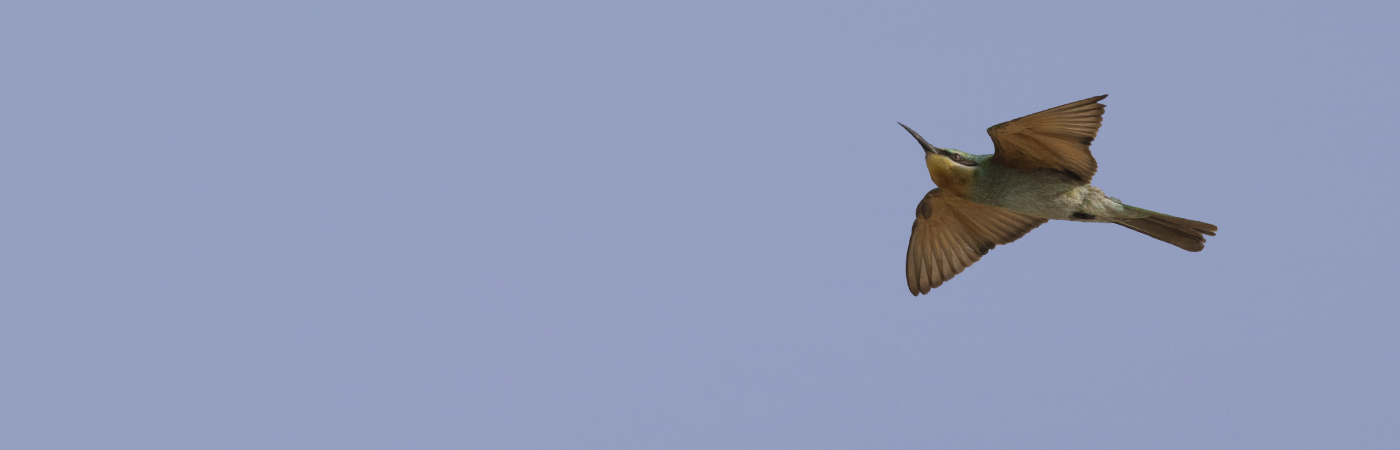
European Bee-eaters were very regular flyovers, some hawked for insects, but most passed overhead to feed elsewhere:
European Bee-eater
Dartford Warbler outnumbered Sardinian Warbler here, I also recorded a single Western Subalpine Warbler.
Dartford Warbler
The drier, more open areas held Rock Sparrows, whose two-tone nasal calls were distinctive:
Rock Sparrow
A typically secretive Cirl Bunting, slipping away into the oak leaves:
Male Cirl Bunting
So this was where all those Woodpigeons and Chaffinches go every autumn. I could see why; I could come here every year.