A cold morning in the city

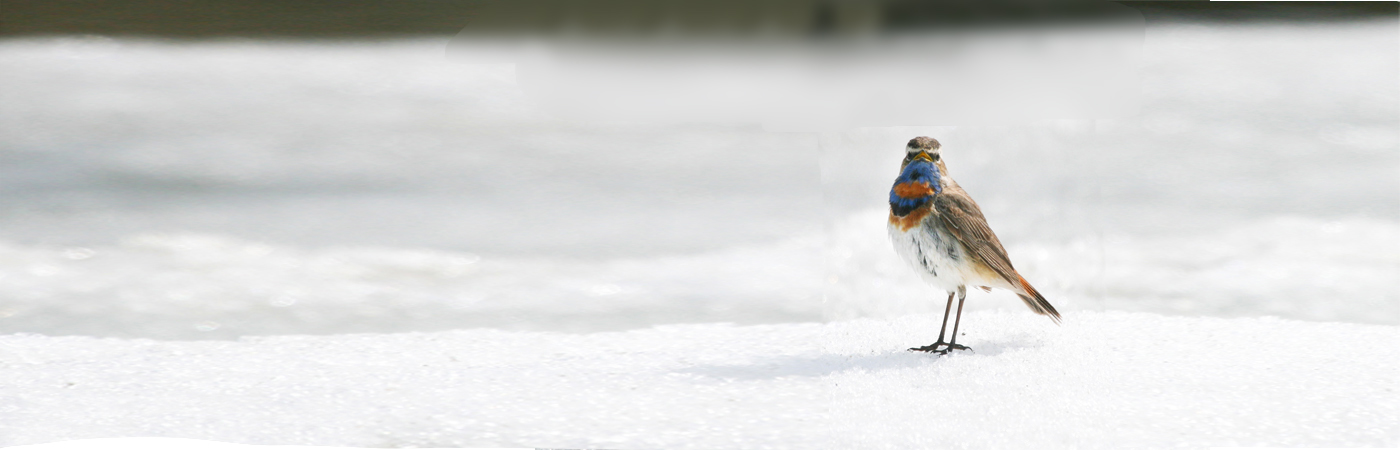
Thursday dawned with pre-work trip into Oxford city to follow up a report from Adam Hartley of a Lesser Spotted Woodpecker in the University Parks. It was a bitterly cold morning, cold enough to freeze the lake in the park and for ice to form on the River Cherwell, above. 

It was still well below zero when I climbed the Rainbow Bridge, perhaps too cold to encourage a small woodpecker to drum. I spent the next 45 minutes checking riverside trees on both sides of the river and listening out for calls or drumming. I found a Great Spotted Woodpecker drumming and excavating a hole, but there was no sound nor sight of a Lesser Spotted Woodpecker. 

Much more obvious were the pair of Ring-necked Parakeets that have taken up residence in the line of trees on the other side of Rainbow Bridge, where the footpath heads north-east towards the end of Edgeway Road. 

With time running out and my fingers beginning to seize up in the cold,  I called into Christchurch College on my way to work:

A Black Redstart, a scarce bird in the county, has been wintering here. This morning it spent its time on the bare branches of the Virginia Creeper on the front of the college, below:

It was perfectly camouflaged, grey plumage against the grey of the branches and the full sun brought the temperature up nicely too. 

 It seems incredible that there is enough insectiverous life on the outside of an Oxford College to support a bird through the winter. But throughout the time I watched it fed constantly, dashing up to take spiders from under the student’s window-ledges, flashing the pale orange tail that gives it it’s name:

I quite enjoyed some city centre birding, especially with Oxford looking stunning on a clear winters morning.

Oxfordshire Birding Awards 2018

Saturday night saw the annual gathering of Oxfordshire birders, at Majliss Indian Restaurant in Abingdon: 

As usual, the event was superbly organised by Badger, who also asked if I would be happy to present the awards again. Despite this, it was a great evening, with good bunch of people, decent food and much beer and wine. It is always great to get the local birding community together and the awards – mostly tongue-in-cheek – are a nice way of thanking people for their efforts over the year. To get an award you have to attend the meal (a hint for those thinking of attending next year!). This year the winners were:

The final award of the evening was a Lifetime Achievement Award for Barry Hudson. Barry is the secretary of the Oxford Ornithological Society and in many ways is the public face of the OOS. As an ex-farmer he has the credentials to work and influence the farming community towards more environmentally sustainable farming methods. Barry’s work on local Tree Sparrow conservation is well known. I first met Barry when he contacted me about putting up nesting platforms for Hobby in Cuddesdon, see here. Always open, friendly and generous, Barry has made a real difference to wildlife conservation within Oxfordshire. As Barry said on Saturday night, we must keep fighting for wildlife, because wildlife itself has no voice. It is our species that will decide the fate and diversity of the various bird, mammal and insect species in Oxfordshire and in the wider countryside. We need more Barry Hudsons.

Great Northern Diver

Somehow I have not seen Great Northern Diver in Oxfordshire. Birds have often overwintered at Farmoor, in some years multiple birds. But all recent records were in my “Cuddesdon years”, when I was concentrating on my local patch, rather than county birding. Just before Christmas this year a juvenile Great Northern Diver was found on a small lake at Beale Park, just over the county border in Berkshire. In the first few days of January reports emerged that it was also feeding on the River Thames, just inside the county. Suddenly it got more interesting.

A quick look at a map revealed just how close to the border this bird was. The county boundary is the black dash-dot line that runs down the river:

The county boundary runs south on the right (east) side of the river until opposite Beale Park (“Wildlife Park” on the map above). Then, inexplicably, it crosses the river to run south, on the left (west) side of the Thames. The lake on which the Diver was first found is fed by a small stream that runs into the Thames at almost exactly the point that the county line crosses the river, just south of two small islands:

Below, Oxfordshire on the right, Berkshire in red, on the left:

So, for me to see this bird in Oxfordshire it needed to be on the River Thames, but south of the feeder stream from the lake in Beale Park. If it was on the lake, or on the River Thames north of the feeder stream, it was in the red zone, aka Berkshire, and was no use whatsoever for my county list. Having established the all important landmarks, I set out this morning to see where the bird was.

I walked up the tow path, passing a Little Grebe, a few Cormorants and lots of Siskins and found the juvenile Great Northern Diver on the river. It was reported to favour the area at the mouth of the feeder stream, but frustratingly, was north of this when I found it, so was in Berkshire. By about 8 meters. The views however, were superb:

It was diving frequently, but also spent some time just loafing, gently paddling against the northerly current, which kept it excruciatingly just outside of Oxfordshire. Surely, at some point it would just float over the invisible line and onto my Oxfordshire list?

It was a dark grey morning, with terrible light, but I took pictures of the bird as it surfaced between dives into the waters of Berkshire.

I was simultaneously enjoying being quite close to a Great Northern Diver and getting frustrated at its avoidance of my home county. Then, after about half an hour, a small group of rowers came up the river from the south. The Great Northern Diver took one look at them, dived deep and long and popped up behind them… in Oxfordshire!

Even more convincingly, it then spent some time well south of the feeder stream. I saw it as far south as the house on the east bank – a whole 250 meters inside the county! Tick.

Chiltern Mandarins

In the absence of time to do any proper birding, a family walk in the Chilterns (about 20km outside of Oxfordshire) produced some nice autumn colours today in the shape of a flock of Mandarin. A non-native species, but one of the better looking ones. Continuing the non-native theme, there were quite a few Ring-necked Parakeet in the woods too, both species seem to be working their way west towards Oxfordshire: 

Devon 2: some moths

We took the moth trap on our family holiday to coastal South Devon in late August. We were staying on the side of a hill, backed by deciduous woodland, but with open coastal habitat nearby. We caught a decent selection of species, as far as our relative inexperience allows us to tell, though conditions were a bit cool and windy to be ideal.Above, always a favourite, Burnished Brass. This individual left some gold dust on my daughter’s finger. Below, Poplar Hawk Moths were frequent. 

Hawk Moths are always a great way to engage children, our nieces loved seeing them. 

Above, our first Marbled Green. Below, the spectacular Jersey Tiger. We saw a few of these day-flying moths locally (photo by our eldest daughter): 

Below, Black Arches: fantastic antennae! 

Above, a Yellow-tail from the only angle you that can see the tail. Below, the wonderfully named Blood Vein (photo by our eldest daughter): 

Above, the common Lesser Broad-bordered Yellow Underwing. Long name, great eyes. There were also Four-spotted Footman and Rosy Footman (below): 

 Each trap also attracted many Shield Bugs, much our daughter’s delight: 

Hummingbird Hawk Moths were very common. A Buddleia bush behind the house usually had a couple buzzing around feeding and we came across them in the village and even on the cliffs above the beach. 

One afternoon our youngest daughter came running to us with some news:

A Hummingbird Hawk Moth had flown through an open window into the house. After much flying up against the windows it finally rested and I caught it in a glass and took it outside. I can’t recall ever seeing this species at rest before. The folded wings completely cover the orange hind-wing and the tail covers the black and white lower thorax. I slipped a piece of white paper under the jar to create a clean back ground for these pictures:

A further treat was bumping into a moth expert. Janet Cheney has just stepped down from being a regional coordinator for UK moth records. She was delighted that we had an interest in moths and kindly offered to come over on our last night and set up her mercury vapour (MV) bulb and moth trap on our patio. These bulbs are seriously bright: 

Below, a view of the village at night: on the far left, the moon; on the far right Janet’s MV bulb, clearly illuminating the surrounding trees and appearing brighter than the moon! The bulb’s reflection is also visible in the sea, bottom right: 

Janet came over the following morning and talked us though our catch. The cold, windy conditions were far from ideal for mothing, but Janet’s expertise and enthusiasm were inspiring. 

Below, Oak Eggar:

Yet another reminder that whilst the wildlife may be the focus of our interest, it is the great people that you meet and learn from along the way the way that is the real pleasure of the journey.

Devon 1: Start Point

I spent 90 minutes or so at Start Point on the morning of Thursday 23rd August. Start Point is in many ways reminiscent of Lundy, with its steep sides, lighthouse and lack of a good low level seawatching position. 

The sea held the expected species: 100s of Gannets passing south with 10s of Fulmars mixed in. 30 Balearic Shearwaters were the highlight, including this flock of 7; 10 Manx Shearwater were also seen, and 2 Common Dolphin slowly made their way south too. 

Whilst seawatching I was bombed by the local Peregrines

… and a single Whimbrel passed low overhead, making me jump by calling loudly. Another Whimbrel on the way back was trumped by this flock of 16 Whimbrel that also flew south calling: 

Overhead passerine migration included a constant stream of Meadow Pipits, 1 Tree Pipit and 3 Yellow Wagtails. There was a nice birdy feel to the morning. As I approached the car park there was a view down to the “lost village” of Hallsands, the empty buildings visible on the seashore, taken by the sea: 

At the carpark Swallows gathered on the wires, feeding up for the push south over the Channel. Both adult Swallows (below) and juveniles (bottom) were present: 

Feeling the Fea: the 2001 Scillonian pelagic

In 2001, as an inexperienced birder who lived far inland, I decided that I needed to see some more seabirds. I had read reports from the Scillonian III pelagic trip in 2000 (see here) and was inspired. Sooty, Great and Cory’s Shearwaters, Sabine’s Gulls and European Storm Petrels were frequently seen on these all day trips from Penzance that headed south west into the Western Approaches of the Atlantic Ocean. But the Holy Grail was Wilson’s Petrel, which in recent years was being seen with increasing frequency. Not having the sort of job where I could drop everything and drive to Cornwall if the weather looked promising for seabird passage, such a trip seemed the best opportunity to maximise my chances of seeing some of the oceanic species of seabird on the British list. However, there was a downside. As the trip report from 2000 noted:

The trip is not for the fainthearted. Many people refuse to set foot on the Scillonian fearing hours of sea-sickness for a brief moment of elation”.

Despite the warnings, I booked my place. In 2001 the Scillonian pelagic was scheduled for 12th August. Then five weeks before the trip, on 8th July 2001, news broke of a huge seabird event off the Scilly Isles. Bob Flood and Ashley Fisher were on their regular pelagic trip from St Marys when a pterodroma petrel was attracted to the chum slick they had dispersed behind their boat. It passed close enough to be seen extremely well and good quality photographs were taken. It was conclusively identified as a Fea’s Petrel, the first accepted British record:

Fea’s Petrel is an extremely rare seabird in British waters. Between 1950 and 2000 there had been just 21 accepted records and none of these could be identified to species level. Instead such sightings were lumped together as “Fea’s/Zino’s Petrel”. These birds are the only northern hemisphere representatives of the Soft-plumaged Petrel group of the southern hemisphere.

Thanks to the experience and skill of the observers, combined with the excellent photographs, the bird seen off Scilly in July 2001 was identified as Britain’s first ever Fea’s Petrel. For those of us waiting to head out into the Atlantic on the Scillonian III in mid-August, this generated mixed feelings. Rare seabird events are, by definition, exceptional. It felt like the big seabird moment of 2001 had happened some five weeks before I would be anywhere near the ocean.

The weekend of 11th and 12th August arrived and I drove down from Oxford to Penzance on the Saturday, an horrendous journey that took nearly 12 hours with the roads filled with stationary holiday traffic. I had fish and chips in Penzance then tried to have an early night at my B&B, near the docks.

It was cloudy and windy as I awoke at 4:30am and forced down some breakfast. I couldn’t quite bring myself to take some seasickness pills, even though I knew that they took 2 hours to work. It was a reflection of my inexperience with the sea that I decided that I would see how conditions were and would then take the medication as required. This was to prove a costly and traumatic decision.

I queued up in the dark and boarded the Scillonian III at 5am. We left Penzance at 5:30am and as soon as we were clear of the mainland, the extent of the swell became apparent. The wind picked up and loud crashes could be heard from the bar and dinning areas as glasses and cutlery were thrown around and smashed. I began to wonder if this was normal for a pelagic trip. After 45 minutes I was feeling terrible. Being outside and looking at the horizon did not help at all. The horizon was thrashing around all over the place as the boat crashed through the swell. Frequently we could hear a loud juddering roar as the propellers were lifted out of the water as the boat pitched violently forward. The smell of the diesel fumes nearly brought up my breakfast. I forced down some seasickness tablets with some water. The complete lack of any seabirds seemed to be upsetting some people, but I had more important things on my mind: I had turned green and I felt like I was going to die.

At 6:45 the inevitable happened. I rushed into the toilets. Every cubicle was locked and the occupant of each cubicle was lying on the floor with their legs protruding out from under the door. As the boat rolled from side to side a large slick of vomit washed from one side of the toilets to the other, coating the legs of the prostrate occupants in stomach contents. I grabbed hold of an urinal, prayed to a God that I did not previously believe to exist, and violently threw up. In a stunned state I opened my eyes slightly and to my horror I saw two, mostly undigested, seasickness tablets, smiling back at me from the urinal. I had thrown up the only two things that were going to make me feel human again.

I crawled back through the vomit lake and managed to get back to my seat, despite the ship pitching and rolling like a roller coaster. I looked out of the porthole next to me and saw my first European Storm Petrels, flying alongside the ship. Never has a British tick had so little feeling attached to it. I forced down more two seasickness tablets, then two more, just in case. I had lost all interest in birding, I was exhausted, covered in vomit and most of it was not mine. The thought occurred to me that there were 15 hours remaining before we were to dock in Penzance. I wondered how I was going to survive this experience.

Fortunately for me the only major side-effect of taking an overdose of seasickness tablets was fatigue. With a recommended dosage of 2 in 24 hours, I had taken 6 in 2 hours, although not all of these were digested. As a result, I passed out in my seat.

I am woken a little while later by a tannoy announcement: “Sabine’s Gull behind the fishing boat at 3 o’clock”. I jump to my feet, but instantly feel violently sick, so I sink back into my seat. I let the Sabine’s Gull go, feeling disappointed as it would have been my first.

By now there are people being sick everywhere. Some hunch over sick bags, some find the downwind rail of the ship. Some attempt to enter the toilets, but it resembles a scene from hell, bodies and vomit were everywhere. And yet, others are not only coping but are birding on the stern of the ship. How anyone could manage that was completely beyond me.  Very few birds were seen during the first eight hours of the trip, fortunately for me as I was incapable of getting up to see them. There was talk of this being the worst pelagic trip in British birding history.

For the next few hours I drift into and out of consciousness, sometimes sleeping, sometimes vomiting. Gradually the winds and swell recede slightly, the seasickness medication finally begins to work and I manage to eat something. Around lunchtime, I feel brave enough to go out on deck and to try to begin birding. We are now at our destination – a featureless piece of the Atlantic, known as the Wilson’s Triangle. Chumming begins, a mixture of rotting fish and fish oils are dumped from the ship, as pelagic bird species are attracted by the appalling smell. I was at the side of the boat, about half way along, reasoning that the centre of the ship moves less than the stern or bow. This position also protected me from the smell of the chum.

The chum began to work its magic. Appearing out of nowhere, bird numbers began to build up. Several hundred Gannets wheel around, plunge diving for larger pieces of chum. European Storm Petrels were everywhere, zipping and flittering over the surface of the sea. Perhaps 200 birds were present. We scanned through them in the hope of a glimpse of a Wilson’s Petrel.

A second Sabine’s Gull was called from the other side of the ship, but I didn’t make it round in time to get onto it. Then my side of the boat had a treat, a Great Shearwater did a close pass, giving fantastic views.

At just after 14:30 there was a tannoy announcement that will stay with me forever: “Soft-plumaged Petrel in the wake!”. I had no idea what this meant. All I knew was that there was a bird so rare that I had not even heard of it, somewhere behind the boat that I was standing on. Simultaneously, every single birder tried to get to the stern of the Scillonian III.

The wake behind the Scillonian III, 12th August 2001 © Tom Bedford

If my senses were working, rather than having been dulled by sleep deprivation, eight hours of vomiting and recurrent seasickness tablet overdoses, then I would have quickly worked out that the bird following the ship was a Fea’s Petrel, one of the Soft-plumaged Petrel group. As it turned out, it was the very same bird seen from the Scilly pelagic five weeks beforehand.

I began scanning through the mass of feeding seabirds in the wake of the ship, just looking for something, anything, different. I got lucky. After ten seconds I got onto a pale grey and white seabird that, as I watched, looped up from just above the sea, wheeled up high above the horizon before skimming back down low over the sea again. I saw the dark “M” across the upperwing and the white body contrasting with the dark underwing.  And then it was gone.

© British Birds 99, August 2006,  p402.

My notes from 12th August 2001, including attempts at recording the bird’s distinctive flight pattern.

There was a moment of silence and then a spontaneous outbreak of joy and applause from those birders that had seen the Fea’s Petrel. Strangers high-fived and shook hands. Unfortunately, only about half the birders on the boat had connected with the bird. They need not have worried. Almost immediately the Fea’s Petrel was located again off the side of the ship, whereupon it proceeded to give a close fly-by down the entire starboard side. As it glided past us, just below eye level, there was complete silence on board, as everyone drunk in dream views of a dream bird. In fact, the Fea’s Petrel remained around the ship for one hour and 15 minutes, still the longest ever viewing of this species in British waters.

2 Wilson’s Petrels were then located, pretty much simultaneously at the front and rear of the boat. The tannoy announced “Wilson’s Petrel with the Soft-plumaged Petrel at 3 o’clock” and was greeted with delirious, incredulous laughter. We could not believe what was playing out in front of us. We had suffered so much, but the rewards had been incredible. At 16:30 we began our return journey. The sea was flat and the sun was shining. The horror of the morning was behind us, we all knew we had experienced something pretty special.

Calm scenes on the upper deck of the Scillonian III on the return journey © Tom Bedford

Postscript:

Just four days later, back home in Oxfordshire, Nic Hallam found a superb adult Sabine’s Gull at Farmoor, only the second record for the county. Even better, it stayed for three days and I saw it. At 25 metres range in lovely evening sunlight. Somehow, pulling back an adult Sabine’s Gull so soon after missing two from the Scillonian III pelagic just added to the magic of the Scillonian experience.

The bird seen from the Scillonian on 12th August was written up and accepted before the record of the bird from Scilly on July 8th 2001, so for a short period it was the first Fea’s Petrel for Britain:

James Lees’s account of the Scillonian III Fea’s Petrel in British Birds:

Since 2001 records of Fea’s/Zino’s Petrel have been almost annual. There were no records in 2006 and 2012, but 6 records in 2009 and 7 in 2013. Most years see just one or two accepted records: 

Contemporary pterodroma identification: Cape Verde Fea’s, Desertas Fea’s or Zino’s Petrel?

To date, there are just 6 accepted species level records of Fea’s Petrel (as opposed to the lumped Fea’s/Zino’s Petrel group):

2001 Isle of Scilly (July 8th, see above)

2001 Western Approaches (August 12th, the Scillonian III bird)

2004 Isles of Scilly

2014 Easington, Yorkshire

2014 Isles of Scilly

2015 Isles of Scilly

There is also a pending record from 2008 of a bird 10km NW of the Galway coast. It is no coincidence that 6 of these 7 records are from pelagic trips. These give a better chance of a close approach and provide the opportunity to gain photographs to allow species level identification of this difficult group. Species specific identification of Fea’s-type petrels is extremely difficult, as addressed in this article by Bob Flood:

The future? 

With Fea’s Petrel firmly on the radar of British birding community, the new pterodroma holy grail of UK seawatching is probably either Zino’s Petrel or Bermuda Petrel. The latter has already come tantalising close to Ireland, see here. Both species have tiny breeding populations and are globally endangered. There have also been some quite remarkable reports of pterodroma petrels, from much further afield. Birds bearing resemblances to Atlantic and Trindade Petrels have been reported on a number of occasions (including this year from Cornwall). There is also a well discussed bird, widely thought to be a Herald Petrel, seen from Dungeness in January 1998:

Finally, if a lucky birder finds a Fea’s-type pterodroma petrel in British waters, they must also eliminate the possibility of Soft-plumaged Petrel, after this outrageous record of a southern hemisphere pterodroma species in the high arctic. The attraction of these magnificent seabirds is partly their  ability to travel vast distances. The challenge for the lucky finder is getting adequate documentation of birds that often pass at distance and at speed. As the BBRC Herald Petrel article notes, a change in seabirding culture towards pelagic trips will help with closer views and allow better photographs to be taken. It is then just a matter of huge luck and of surviving the trip if the weather is inclement!
The Big Blue: the new Abingdon super-reservoir

And still they torture us with talk of an enormous reservoir near Abingdon:

http://www.oxfordmail.co.uk/news/16393158.abingdon-reservoir-ed-vaizey-demands-second-consultation/

I see the future of Oxfordshire birding… and the future is good!

Emperor Moths, from egg to cocoon in 6 weeks

Earlier this year we were fortunate to be given some Emperor Moth eggs by Martin Wainwright, author of the excellent “Martin’s Moths” blog. I saw a blog post by Martin offering eggs and took him up on his offer. Martin used to be the northern editor of the Guardian and unbeknown to him, the Country Diary section of that newspaper was something of an influence on my early adolescent self. I would turn to the Country Diary page (yes children, imagine turning pages of paper to find something of interest!) to see if there were snippets of information or descriptions of bird life from around the UK. It was a brief wildlife moment in the chaos of a large family breakfast routine. I recently discovered that Martin has published a collection of writings from The Country Diary, “A Gleaming Landscape: 100 years of the Guardian’s Country Diary“. Martin helps publicise moths enthusiastically and can be said to have brought moths to the people! The Emperor Moth eggs he gave us were tiny and sat attached to the corner of an eggbox: 

Little happened for a few days and then on May 16th the eggs began to hatch. Below, the freshly emerged caterpillars having their first taste of Hawthorn leaves. The eggs are visible in the background:

The first caterpillars are nearly entirely black in colour. There is just a hint of green at the base of the hair nodules: 

We then embarked on a month of daily Hawthorn leaf gathering. Fortunately, Hawthorn is one of the most abundant trees:

The caterpillars grew very rapidly, but their skin can only stretch to a certain limit. After nearly two weeks, the first caterpillars (known as first instars) shed their skin to reveal a larger black and orange skin. These are the second instars, the second stage. Below, Emperor Moth caterpillar transformation from tiny black first instars to huge green fourth instars in the space of just over a month. My left thumbnail is being used to give some idea of scale: 

Below, a fourth instar Emperor Moth caterpillar emerges from it’s third instar skin: 

The fourth instar caterpillars were big beasts. After a month the tank was filled with alarmingly active, huge green, black and yellow caterpillars. We were now up to three feeds a day!

The largest caterpillars were between 6 and 7 cm in length:

Emperor Moths are related to silk moths. After 6 weeks some of the adults began spinning their cocoons: 

The silk that they produce is silvery white in colour at first. They gather twigs and leaves in around them: 

In the centre of the picture below, you can make out the head of the caterpillar through the hole in the top of the cocoon: 

The silk then dries and ends up being a gingery colour. It sets as hard as steel. The caterpillars will spend the rest of the summer and all winter in their cocoon, before they emerge in April as adult moths. The energy that they derived from the Hawthorn leaves will sustain them all winter and for all of the adult life of the Emperor Moth. The adult moths do not feed. Their purpose is to emerge and mate and then they die. The moths (and butterflies) that we see on the wing are only the brief final adult stage of an insect species that spends far longer as a caterpillar and as a pupae, sometimes in a cocoon, depending on the species. In April 2019 we await the delight of the adults emerging, although Martin mentioned that sometimes they may skip a year and emerge two years after they have pupated. Emperor Moths are fantastic, large, beautifully marked moths. The larger females emit pheromones, attracting the males (below) with scent. And then it all begins again: mating, eggs, caterpillars and cocoons.

[image © www.ukmoths.org.uk]

Many thanks to Martin for his generosity and enthusiasm in our Emperor Moth project.

The new Handbook of Western Palearctic Birds

The fabulous new two volume Handbook of Western Palearctic Birds, by two giants of Western Palearctic bird identification Hadoram Shirihai and Lars Svensson,  arrived today. This was a bit of a surprise as the advertised release date was July 26th, but I am not complaining, as it appears to be superb: 

It is a photographic guide, but one with forensic attention to detail, covering all plumages for all age groups, as well as examining subspecies and geographic variation. Usually looking at a photographic field guide involves looking at other people’s pictures – but not this time! Back in 2008, having just returned from a trip to Morocco with Richard Campey, I read a request for pictures of certain species and plumages advertised in (the now extinct) Birding World. I sent in two pictures. Producing two volumes with such a wealth of detail obviously takes time, so it was ten years later that I received confirmation that both images have been included. There are 5,000 fabulous photographs across the two volumes but I went straight to page 469 and page 506, where my female Western Subalpine Warbler… 

… and my Western Olivaceous Warbler (now re-named Isabelline Warbler) awaited me. 

It was also a novel experience getting payment for a picture. At £25 a photo (assuming all photographers were paid the same amount) the photographic costs alone of the two volumes must be in the region of £125,000. The book will have provided a useful spike in income for some well-known bird photographers. It is expected that this book will become the standard identification text for the region for years to come, which combined with the photographic costs, may explain the RRP of £150. I have only flicked through both volumes, but already I would recommend it to anyone. Especially pages 496 and 506  🙂

error: Content is protected !!