Shetland 22: in the beginning.

In the beginning, God created the heavens and the earth. Now the earth was formless and empty, darkness was over the surface of the deep, and the Spirit of God was hovering over the waters. And God said, “Let there be birds,” and there were birds. But only the few would see them. And to do this, they had to pay the price.

The Birding Gods are fickle beasts. They give with one hand and take with the other. Having been deprived of a trip to worship the birds of Uganda with Dave Lowe and Ian Reid by a serious bike accident in June, I reasoned I had suffered enough. The Gods thought otherwise. I spent the summer recovering, walking, then cycling again. A planned trip to spend a week on Unst with Andy Last had looked in jeopardy, but I worked hard on my recovery and by late September, felt physically capable enough to commit to travel. This year, we would not base ourselves on Mainland Shetland, but rather headed north, to spend the week on Unst, home of the most northerly house, post office and lighthouse in the UK. We would be closer to the Gods. We would concentrate on finding our own birds. The Birding Gods would be pleased.

We left Oxford at 6am on Monday 26th September. A day I’ll always remember. Cause that was the day my belief in the benevolence of the Birding Gods died. By lunchtime, we were just south of Glasgow. We pulled into a service station. I glimpsed a thumbnail of a picture message from Jason arrive on my phone. I said to Andy “I think there’s a Nightjar in Oxfordshire“. Then, immediately, this:

The shock that rippled through the Oxfordshire birding community also rippled through us, in Scotland. But, unlike the other seventy people on that group whose lives at that very point in time had been thrown into chaos and who were desperately planning how they could escape work, family, or indeed any other sort of commitment at all, we were very calm. We were calm because we immediately knew we would not see this bird. It was six hours back to Oxford and we had a ferry to catch to Shetland that evening from Aberdeen. There was no decision to make. HAD I NOT SUFFERED ENOUGH? Obviously not, it was quite simply the best bird ever to turn up in Oxfordshire. A North American nightjar: better than the Oriole. Better than the Scops Owl. Better than the Surf Scoter. Much better than the Buff-bellied Pipit. It did not take long for our calm to turn into pain. We drove on. We suffered. We were well past Stirling before we spoke again. Andy turned to me and said, “Is it still there?” I checked and nodded, “Showing beautifully in the sunshine“. We birded the Girdleness peninsular, next to the Aberdeen ferry terminal, and found a Little Gull. At precisely the moment the Nighthawk took off from its fence in Wantage to continue its migration, our ferry pulled away from the docks in Aberdeen, into the teeth of a fierce north-westerly gale. It was going to be a rough night. Clearly, I had not suffered enough.

The next morning, our arrival in Lerwick was delayed by a couple of hours by the headwinds, so we had the chance to look for seabirds from the ship as dawn broke. In amongst the Fulmars, Gannets and occasional Bonxie, we found 5 Sooty Shearwaters shearing their way south through the North Sea. We docked in Lerwick, caught up with the Glaucous Gull in the harbour and the drake Surf Scoter at nearby Gulberwick, before we headed north to our home for the week, the most northerly island of Unst.

Glaucous Gull, Lerwick Harbour

We were based for the week in Uyeasound, right by the harbour and right by the Otters. We checked the local area every morning for migrants, before birding north through the island.

Uyeasound, on the south coast of Unst

Shetland in autumn is the land of Yellow-browed Warbler. They were out in force again this year, after a quiet year last year:

Some birds were quite vocal and we heard calling birds most days:

Most places had Common Redpolls too, calling fly-over birds were frequent:

But one of the highlights of this autumn was the influx of the big beasts from the north, Hornemann’s Arctic Redpolls. The birding machine that is Geoff Wyatt, found one just outside Uyeasound one afternoon when Andy and I were up in the north of the island, which we caught up with later in the week. We slipped off the island once, just to Mid Yell about 30 minutes away, to marvel at this fabulous white beast, before vowing that we must find our own:

At the ferry port this Minke Whale surfaced close by, the sound of its blow ringing around the bay, drawing attention:

Common migrants were a little thin on the ground, but sites with cover usually held something. We found Redstarts, Lesser Whitethroats and a Garden Warbler in various places, plus…

Spotted Flycatcher
Brambling
Meadow Pipit
Snow Bunting
Fulmar
Whooper Swans

Occasionally we popped in to pay homage to a local scarcity:

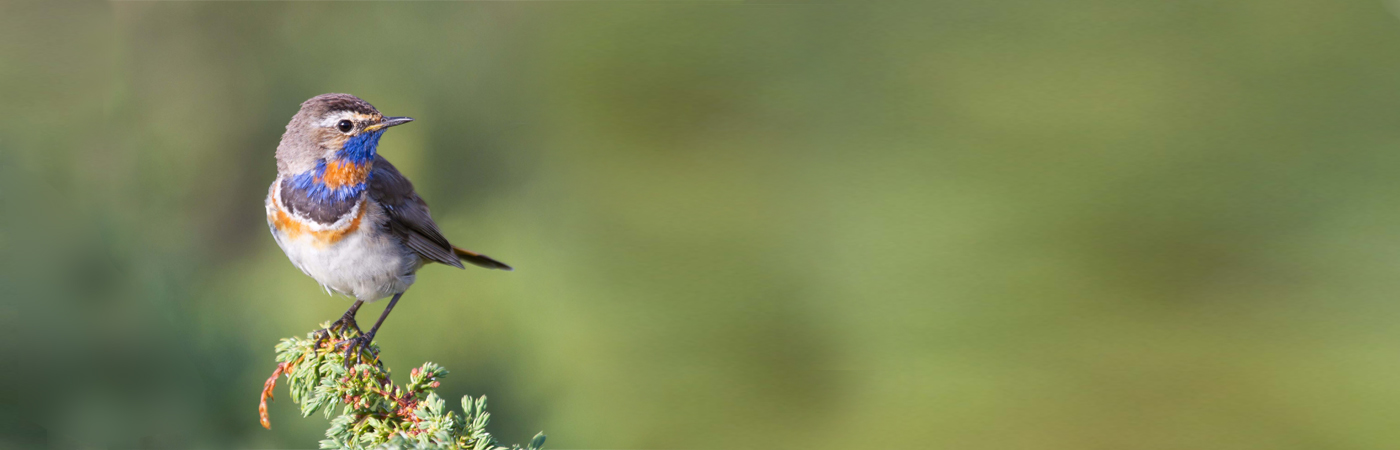
Bluethroat
Barred Warbler – photo by Andy
Red-backed Shrike – photo by Andy
Ortolan

We enjoyed an hour at Burrafirth, pictured above, one afternoon, with fog and clouds rolling in from Hermaness. We both thought we heard a Yellow-browed Warbler call from the bracken on the hillside. A quick clamber up revealed there was one, and a Willow Warbler and in the valley a Whinchat. Hermaness had no migrants, but still had good numbers of Great Skuas, we had 12 together at one point.

Andy at Hermaness
Me

But we sensed something had to change. We were finding birds, but just not the right ones. Andy’s camera stopped working after four days. I took this as a good sign. Is there a better way to get a close, beautifully lit view of a good bird, than not to have a working camera at hand? We couldn’t think of one. Another day passed. We considered whether we should take this strategy a step further and submerge all our optics in the Pool of Sacred Tears (aka the small garden pool by the road out of Uyesound):

This thought process paid immediate dividends, with Andy getting a glimpse of a small dark crake running between the willow bushes in the background. It was nearly dark before it ran back, confirming its identity as a Water Rail. We flushed this bird from near this area as we walked back along the road the following morning too.

We went back to the Gods for advice. Andy re-created the moment that the mighty sea-birder Erik the Red scored the first Fea’s Petrel for the North Sea in AD65, from this longship near Haroldswick. But the Gods were not amused. I slipped on the deck of this boat and twisted my injured leg. Had we suffered enough? Had we paid the price? Would we get our reward? Find out next time in “Shetland 22: the end”.

More Oxford Tree Pipits

This morning’s visit to the parched Southfield Golf Course/Lye Valley area produced a couple of classic late-August migrants.

First up was a vocal Yellow Wagtail. Yellow Wagtails are recorded annually as fly-over migrants, but I am not aware of one ever being seen on the ground here. That all changed this morning when one flew over calling and as I watched, it dropped out of the sky to land on the golf course and begin interacting with 2 Pied Wagtails:

This bird called frequently. I recorded the flight calls using video on my phone and then downloaded them:

As I was watching the Yellow Wagtail on the ground, a loud, buzzing “tzeep” call from low overhead told me that my day had just gotten significantly better: the second Tree Pipit of the autumn was passing over. I just managed to capture a single flight call, as it headed south:

The regular appearance of Tree Pipits around Southfield Golf Course in Oxford city in late August and early September is still a puzzle. Historically, Tree Pipit is a scarce migrant and occasional rare breeding bird in Oxfordshire, although Tree Pipits were recorded regularly on this urban hilltop golf course as long ago as thirty years ago (per Steve Heath). I failed to see or hear any in 2019, but Tree Pipits have been recorded in each of the three years since, with all records between August 24th and September 8th.

Not all of these records are fly-over migrants. Last year I found a silent, feeding bird in the small meadow behind the Churchill Hospital (see photo below) and in 2020 one was heard calling at dawn from hawthorn scrub on the golf course. Dave Lowe has suggested that migrant Tree Pipits may roost in scrub and trees on the golf course and are being picked up at first light as they leave to continue their migration. Whatever the attraction of Southfield Golf Course to Tree Pipits, their annual appearance is one of the highlights of the early autumn migration period. Tzeep!

Out of the darkness and into the light

Let’s start with the good news: I am going to survive this. The bad news is that I had a terrible bike accident two weeks ago. I crashed on a high-speed descent and sustained serious soft tissue injuries that required 9 days in hospital and two rounds of surgery, including a skin graft on my right thigh. I am eternally grateful to my cycling companions (Michelle, Andy Last and Ben Sheldon) for administering first aid in pretty traumatic circumstances whilst we waited for the ambulance to arrive. 

Once the surgeons at the John Radcliffe in Oxford had finished their work, there was a five-day wait to ensure that my skin graft had taken. The vacuum dressings could not be removed during this period, so this was a straight five-day wait in a hospital bed. 

As I was unable to move or get up, I was fortunate to have a bed next to a window. The days blurred into each other, I spent hours alternating between watching clouds and trying to nap to fight the crushing sleep deprivation of being in hospital, when you are woken every two hours to have your vital signs assessed. 

But if you can see the sky, then you can see birds. A routine began to emerge. I began keeping a daily e-bird list of the species that I could identify from my hospital bed. The hospital has a large Feral Pigeon population, these and the local Woodpigeons were the commonest species, along with Red Kites and Crows. Twice a Grey Heron flew slowly overhead, and once a Little Egret passed right over my side of the building, black legs and yellow feet, trailing behind it.  It gave me pleasure. I smiled. 

I was allowed to keep my window open, so sometimes could hear bird calls. Dawn is very early in June, but not as early as the nurses and their medication rounds. I heard Blackbirds singing, Wrens calling and Swifts screaming. One morning, at about 4:30am, I heard a singing Chiffchaff in the dawn. I was transported back to happier times, hearing this species announcing that spring was here. These connections with the outside world, and between my past and my present were incredibly therapeutic. When you are trapped in a hospital bed, anything that takes you to another place or time is very precious. 

The staff and surgeons in the hospital were fantastic and I am expected to make a full recovery, though my leg may never quite look the same. To every person who visited me in hospital – thank you, it means more to me than you will ever know.

So, here I sit, in my garden on a hot summer’s evening, with Dave Lowe. My leg is in a brace, I’m forbidden from bending it for two weeks, but can walk with crutches. Above us, some form of aerial insect hatching event is taking place, There are several hundred gulls circling above Headington, flycatching. Swifts join them, as does the occasional opportunistic Red Kite. I scan through the gulls, beautifully lit against a blue sky. As always, most are Lesser Black-backs, with a few Herring and Black-headed Gulls in with them. Then I find myself checking for Mediterranean Gull, dreaming of Yellow-legged Gull. I smile. It’s going to be OK. 

Great White over Headington

For a district that is 67 miles from the nearest sea, it seems strange that Headington is associated with sharks. But Bill Heine’s fabulous fiberglass shark, which protrudes 25 feet above the roof of the house he owned in New High Street, is probably the most famous thing about Headington. It also looks pretty good at night too, here pictured with Comet Neowise in the summer of 2020:

I had my own Great White experience in Headington yesterday morning. It was a routine Saturday morning dawn visit to Warneford Meadow and the Lye Valley. Perhaps early spring, if I really squinted hard enough, but really it was late winter. March 5th is slightly too early for the mass of waterbird migration that should kick off from mid-month and will probably pass overhead elsewhere, but as with all local patch birding, you just never know. So I keep going, just in case. A singing Nuthatch and drumming Great Spotted Woodpecker were positive signs many bird species were entering their breeding cycles. Displaying Greenfinches were obvious too, and Chaffinches had recently started singing.

I watch the skies constantly, as nervous as Vitalstatistix, who lived in fear of them falling on his head. My anxiety was not over the impending collapse of the atmosphere, but of missing a migrating bird flying over. Or worse: of only seeing it when it was already too distant to identify. The vast majority of my scans of the sky reveal either nothing or just Woodpigeons. But if you do something enough, eventually something will happen. Or at least, that is what I tell myself.

At 7:23am, I notice a shape in the sky. High above the Churchill Hospital, flying away and slightly east, it has deeply bowed wings and is quite large. I furrow my brow and raise my binoculars, whilst the words “Grey Heron?” begin to form in my mind. The data from my eyes immediately answer this question in the negative – the bird is pure white, above and below. “F**k, it’s an egret” I mutter, whilst quickly swinging my camera around to capture some pictures. Whilst the motor part of my brain works away on the logistics of getting some pictures of a distant white bird flying away from me against a white sky, the inquisitive part of my brain is still wrestling with the identity of this bird, from what I can see through the viewfinder, whilst I take pictures. “Looks big, very deep wingbeats – got to be a Great White?!” I ask myself, without really taking on the meaning of this.

By now, the bird is distant. My camera is not going to help me much more. I put the camera back on my shoulder and go back to a binocular view. The bird is struggling a bit with the stronger gusts of wind and drops down slightly in front of Shotover Hill, before rising again and continuing its journey east. A local Red Kite provides a nice point of comparison as they pass near each other, both birds appearing a similar size in flight.

Finally, I can hardly see the egret anymore, so I turn and review the pictures on the back of my camera. It IS a Great White Egret! The long, dark legs, trailing behind the body are just visible, as are the deeply bowed wing on downbeats:

You can just about make out the yellow bill here and check out the length of those wings:

Wow, what a start to spring 2022, or what an end to winter 2021-22! Either way, this is an amazing record of Great White Egret over Headington, Oxford, and a great incentive to continue dedicated coverage with spring migration just around the corner. What else might fly over before the sky falls on my head?

Pallas’s Warbler

On one hand, it was expected. But on the other, completely unexpected. Pallas’s Warblers are very rare inland. But, very occasionally, a Pallas’s Warbler will spend the winter in the UK. I can recall a bird in the south-west that stayed and even began singing in early spring. One even wintered as close as Berkshire in 2013, but this was an exceptional record. Realistically, Pallas’s Warblers are rare birds of the east coast in late autumn. They are a great find anywhere being tiny, beautiful birds and all birders love them. There has never been a Pallas’s Warbler in Oxfordshire, and quite feasibly, there may never be one. Until Gareth Blockley found one yesterday afternoon.

At 15:48 the county rang to the sound of expletives as Gareth broke the news of his astonishing find:

We can forgive Gareth for his mis-spelling of the bird’s name. The magnitude of the find and the myth of the Pallas’s Warbler is such, that lesser men than Gareth would have been rendered unconscious at that moment. Gareth found and identified the bird and got the news out, with diagnostic pictures. These are the acts of legend in Oxfordshire birding.

Unfortunately, within 40 minutes of the bird being found, it was dark. Only two other people saw the first Oxfordshire Pallas’s Warbler that day. There then followed a contender for the most tense evening ever in Oxfordshire birding history. Would the bird stay? Would anyone else see it? Would it survive a night several degrees below zero, indeed the coldest night of the entire winter?

Well before sunrise, in bitterly cold conditions, local birders began gathering in the line of trees where the bird was last seen. By sunrise nearly 40 people were present and we pretty much all knew each other.

Bird activity began. It went something like this: Blue Tit. Chiffchaff. Long-tailed Tit. Chiffchaff. Chiffchaff. There were a lot of Chiffchaffs. Blue Tit. Chiffchaff. Chiffchaff. And so it goes. A freezing hour passed. Another freezing hour passed. The procession of Chiffchaffs continued.

Then, finally, a shout from Pete Roby. Running. Looking. More running. And in the back of an alder tree, a yellow and gold gem zips about manically: the Pallas’s Warbler. The bird is very mobile. In binoculars I get a flash of the rump as it powers up into the crown of the tree, followed by views of the head pattern as it pauses, before darting across the track to feed high in alders further along the path.

Photographs are pretty much impossible, though I do try. It is dark, the bird tiny, hyperactive and silhouetted.

Pallas’s Warblers are so breathtakingly beautiful, that every trip to see one is built on dreams of images like this:

Where the reality is so often, much more like this!

But we didn’t care. We had seen an Oxfordshire Pallas’s Warbler and that is very, very special.

The author would like to thank his support group for their help in writing this article without using the phrase “seven-striped-sprite”. Thank you.

Shetland 21, part 4: keep calm and carry on.

In a week of predominately westerly winds, it was pleasantly surprising to see new birds from the east arriving, as well as to catch up with some eastern species that arrived just before we did. There was also one rare wader from North America, a Semipalmated Sandpiper. In 2019 we had superb views of this species at Grutness:

This year another Semipalmated Sandpiper turned up across the bay at Pool of Virkie, favouring a small pool in the field next to Roger Riddington’s house. We decided not to try and get too close, but watched from a distance using our ‘scopes. It was in company with a juvenile Little Stint, at one point interacting with it and perching on the Stint’s back for a few seconds. In changing light, the distinguishing features from Little Stint varied from obvious to not very obvious and back again.

The Radde’s Warbler at Kergord got my vote for being one of the top three birds of the trip. It was typically difficult to see, but with a bit of patience we managed to piece together a view of the head and bill, then a flash of the pinkish-buff vent and tail as it disappeared before finally, we got a brief view of the whole bird for a moment and then it was back out of sight, creeping around in the base of a rosehip bush. As it was quite dark, we all choose to favour views of this bird, rather than photos, but Ewan Urquhart managed to get a nice picture of the bird as it perched out when he visited:

Photo by Ewan Urquhart

Also from the east was a Barred Warbler at Gulberwick, which perched up briefly before flying across the road:

A juvenile Common Rosefinch at Wester Quarff held particular interest for Andy. We visited this area on 9th October, a day that was forecast to be washed out by rain. We hoped to get an hour or so of birding in before the rain arrived, but even by 7:30am, when barely light, the rain began to fall. The Rosefinch was in a small (turnip?) crop by the road to Wester Quarff, so there was plenty of cover for it to shelter within. After over half an hour of standing in the rain searching through the Chaffinches, Brambling and Meadow Pipits that flitted around the crop, Dave and I were beginning to wonder at the point of this exercise. Especially when the best possible outcome was seeing a juvenile Common Rosefinch in the rain. But Andy has something of a Rosefinch obsession. We discussed how long we wanted to give this bird. I suggested another 20 minutes, to which Dave agreed, providing that included the 19 minute walk back to the car! However, Andy announced he wanted to give the Rosefinch another hour (!), so Dave and I agreed we would walk back and began scanning the bay for the eclipse drake King Eider, whilst Andy maintained his Rosefinch vigil. It all worked out in the end. I picked out the King Eider, Andy’s persistence paid off when the Rosefinch appeared and we all saw both birds:

The degree of Andy’s Rosefinch obsession can be demonstrated by the traditional bird-of-the-day discussion that the evening. We lost nearly the whole day to weather, so there were only two contenders: a drake King Eider and a juvenile Common Rosefinch. I would wager that 99% of birders would see this as a no-brainer. One is a dull brown juvenile finch, the other a magnificent brightly coloured sea duck, with a fabulous bill, just coming out of full breeding plumage. But not Mr Last. Dismissing the drake King Eider as “just another duck”, he then began to sing the virtues of the flank streaking, the wing-bars and even the evil beady eye, as positive virtues for the Rosefinch. Fortunately, democracy prevailed, with two-votes-to-one for the King Eider.

A Bluethroat in Burrafirth Quarry was one of the better marked autumn birds that we’ve seen, though it was very good at hiding in the dead thistle beds:

The juvenile Woodchat Shrike at Aith, worked its way up and down the fence line behind the houses. This bird had rather smart wing feathering. The pale-centered lower scapulars, with sharp chocolate brown edges contrasted with the dark-centered, pale-fringed greater coverts. The white patch at the base of the primaries was obvious and the primaries tips had pale fringes too:

A Rustic Bunting, found near Kegord, which also hosted the Radde’s Warbler, attracted a few birders:

Shortly after we arrived the Rustic Bunting flew along the hedgerow calling with a distinctive short, compressed, high-pitched “zit” call and perched up on the other side of the hedge. We knew this from the cascade of camera shutter noise we could hear. Seeing the photographers advance towards the hedge, we decided to wait on our side of the hedge to see if the bunting would appear there. The bird dropped down to feed out of sight, in a long ditch that separated the two fields. We waited. And waited. After 20 minutes a single “zit” call rang out from a bush 10 meters down the fence line from where the bird was last seen. I looked across at Andy and knew that he had heard the call too. We both move down the fence line and focus our attention on this bush. Suddenly Andy calls out “there it is!” and there, perched low down in the bush in front of us, is a rather fabulous Rustic Bunting:

Photo by Andy

Another nice bird from the east was this ghostly Siberian Chiffchaff which appeared in front of us in the small quarry at Quendale on a very wet late afternoon. We met Dan Brown and James Eaton working the iris beds here, Dan was using a thermal imager to try to pick out heat signatures from birds moving within cover, a glimpse of the future in migrant hunting perhaps?

That evening Dave and I went to a meeting of the Shetland Bird Club to hear a talk on Hummingbirds by local Shetland birder Jon Dunn. Jon began his talk by illustrating why he is so drawn to Hummingbirds by contrasting them with “dull migrant species” like Siberian Chiffchaff, the very species we had found at Quendale that evening. I like to think they have a subtle, delicate beauty of their own Jon!

Finally, our visit to Shetland ended with another lesson in remaining calm and reviewing evidence. News broke of a possible Eastern Yellow Wagtail at Gulberwick on our final afternoon. The bird was feeding in a sheep field:

The bird was a grey juvenile Yellow Wagtail, but as Dave asked whilst we watched it, was there anything about it that made it an Eastern Yellow Wagtail? It did not call whilst we were there, so there was no definitive evidence. We noted the slight yellow wash to the vent and at certain times the mantle had a very slight brownish hue to it. It was certainly not a classic monochrome individual. The following day a recording of this bird’s call was made, which confirmed that it was a Western Yellow Wagtail. Once again, the temptation to go for the rare option, that on Shetland in October is magnified by the location and the date, needed to be resisted. Keep calm and carry on!

Shetland 21, part 3: pipits and ditches

On 5th October we visited Channerwick on the east coast of Mainland Shetland. It is a superb-looking site, with enough sheltered cover to attract migrants, but not too much as to make finding them a daunting task. Two notable things happened here. Firstly, we saw and heard Olive-backed Pipit; secondly, I put our car in a ditch as I reversed out of the site. Let’s look at both those incidents, starting with the one that has generated the most conversation. Sadly, it is not the pipit.

It was a simple, though embarrassing, misjudgment. I wasn’t even the only person to ditch their car that day, as Penny Clarke put her car in exactly the same ditch that same afternoon. Fortunately, Andy and Dave dealt with the delay without fuss or drama. They went birding whilst I called for the tow truck. Below, the resuce, with help from the tow-truck and a group of visiting birders. Thank you, to all of these people:

At times like these, it is good to know that I have friends who will quietly support me at difficult moments, who will not send pictures of my handiwork to everyone they know or say “mind the ditch” every single time that I park for the duration of the trip. Unfortunately, those friends were not with me. So the next day when I bump into Sue and Roger Wyatt from Oxfordshire, Roger greets me with the words “Who put the car in the ditch then? Ian Lewington sent me a picture!” Later the same day, Andy receives a picture of our car in the ditch from Terry Sherlock and Wayne Paes in Oxford, who ask for an explanation of how it got there. Word was well and truely out. Oh, how those long autumn evenings flew by.

Now, back to the pipit. An Olive-backed Pipit had been reported at Channerwick, but we were pleased to see that we had the site to ourselves when we arrived. We would find the bird ourselves. Andy stayed near the sycamores and tree cover, Dave headed south towards the shore, I checked the burn and the fields opposite:

Dave found the pipit in the scrub and rough fields to the south. It was elusive and only gave flight views initially, before showing beautifully to Dave and Andy. By the time I joined them I had more distant views, but twice heard the flight call. Below, Olive-backed Pipit, photo by Andy:

On 8th October we headed north to Unst, arriving at one of our favourite sites, the small woodland of Halligarth, at 8:15am. As we walked down towards the gate to the wood, I heard and simultaneously saw, a pipit flying towards us with an explosive high-pitched flight call. I called out “interesting pipit coming over” and we, and two other birders, watched the pipit drop into the canopy of the wood. Had I been visiting my patch in the Lye Valley, Oxford, I would have added Tree Pipit to my checklist and moved on, happy with a good find. But this being Shetland, in October, there is a temptation to reach for other, rarer options. So, on the basis of hearing a single flight call, which I thought similar to the Olive-backed Pipit we heard at Channerwick, I called “Olive-backed Pipit?” We needed to see, or at least hear, the bird again.

We watched from outside the wood, got a glimpse of the bird fly out and then disappear into the sycamore canopy once again. There then followed about half an hour without sight or sound of the pipit. The two other birders we had met outside of the wood then flushed the pipit from the rough fields to the south of the wood. We all saw and heard the bird fly past the wood to perch on distant wires, before dropping into a cattle field to feed. After this fly-by, none of us felt confident to identify the bird on call alone, but it was either a Tree or an Olive-backed Pipit. One of the birders we had met played recordings of the flight call of both species on his phone. Tree Pipit sounded much more similar to our bird, a fatter, more buzzy call, slightly lower-pitched than the thin, high-pitched flight call of Olive-backed Pipit. But we were also aware that there can be an overlap between the two species’ flight calls.

Dave and I decided to re-find the bird in the field and I would try to get a recording of the flight call on my phone. This worked a treat. The flight calls are at 11 and 14 seconds. The wood at Helligarth can be seen in the background:

We got some distant photos of the bird perched on a wall a little while later, but little could be seen on the back of the camera, so we parked the ID of this pipit until the evening when we could review the evidence at our accommodation. In the meantime, the two other birders we met had put the news out that an Olive-backed Pipit was present at Halligarth. By now, we weren’t quite so sure.

This is the sonogram of the key moments. The faint purple haze below 2kHz through the recording is wind noise, with a loud gust at the 3-second mark, which creates the faint vertical purple column between the pipit flight calls:

Examination of the sonogram taken from the video (for tech-geeks, a .MOV file converted to .WAV file and then processed using Audacity) shows a number of things:

Firstly, the frequency of the pipit’s flight call. Although not completely diagnostic (see this technical article by Avesrares here) Tree Pipit flight calls rarely exceed 8kHz. I would say the flight calls we recorded barely exceed 7 kHz. The Avesrares article shows Olive-backed Pipit flight calls peaking at about 8.5-9kHz, significantly higher-pitched than our bird.

Secondly, the mooing of cows is at a very low frequency, somewhere between 1 and 4 kHz. Incredibly, Dave’s broad Bolton accent is at a lower frequency than a cow moo, below 0.5kHz, though the two are rarely confused in the field. The sonogram also captures Dave’s reaction time between hearing the flight call and calling out “there it is!” The flight call ends at the 2s mark. Dave’s voice begins at about the 2.5-second point, quick work Dave.

So, to cut a long story short, we saw and heard a Tree Pipit. But now we know exactly why and more importantly, why it was not an Olive-backed Pipit. This was an educational pipit and we all felt more informed for it. However, distinguishing this species pair on flight call alone is not always straightforward. If an Olive-backed Pipit flies over your head calling, you need to hope it is one with a call at the more obvious end of the spectrum – the higher-pitched, thinner and less buzzy, the better! Take a listen to these examples from xeno-canto:

Tree Pipit: Lars Edenius, XC668177. Accessible at www.xeno-canto.org/668177.
Olive-backed Pipit, but at the less obvious end of the spectrum:
Jelle Scharringa, XC653907. Accessible at www.xeno-canto.org/653907.
Obvious Olive-backed Pipit:
Nicholas Galea, XC533890. Accessible at www.xeno-canto.org/533890.

Many thanks to Mick Cunningham for his thoughts and input on our pipit calls too.

Next: goodies from the east, despite the winds.

Shetland 21, part 2: a blast from the north

This year there were a number of arctic breeding species present on Shetland. A telescope was needed to view some of these species, as they could be quite distant. An undoubted highlight was the summer plumaged White-billed Diver, found by Jono Lethbridge’s group, at South Nesting. Any summer plumaged diver is a magnificent sight and White-billed Diver has that rarity value too. A stunning bird in the ‘scope, it was way too far out for photos, but I gave it a go anyway:

Below, second place in the “Diver Awards” went to the very smart Great Northern Diver, that Dave and I watched fly past from Grutness. This was one of many present in summer plumage that we saw around the islands. We also saw winter plumaged birds and Red-throated Diver.

Getting even more distant was the second-calendar year King Eider that was found with the Eider flock at Girlsta. This was the ultimate in distant birds. In binoculars, the entire Eider flock was miles away, a thin line of brown and white on the far side of the bay (*confession, I have just measured the distance on Google Earth, the flock was almost exactly 1km/0.6 miles away from us. Which is still quite a distance to pick out a 60cm long sea-duck) :

Picking out the King Eider was a nice challenge, won by Andy, on this occasion. The glowing orange bill was the most obvious initial feature. It was a minor miracle that we got a picture of the bird at that distance, but modern cameras never fail to amaze:

A telescope was also required to pick out the first-winter Glaucous Gull in the gull flock on the far side of Loch Spiggie:

Later in the week, we visited Wester Quarff, where our second King Eider, an eclipse drake, could be found. Fortunately, it was closer than the Girlsta bird. This was a smart bird in the ‘scope, though the light was very poor for photos that day:

Northern passerines were more accommodating than some of the sea-duck. We found Snow Buntings at Lamba Ness on Unst (13) and at Scatness on Mainland. They are always great birds to see:

Brambling was the dominant finch species, replacing Common Redpoll, which was everywhere during our 2019 visit. Most areas of tree or shrub cover held a few, they are always a pleasure to see and hear:

Scatness is the central line of land in the picture below, taken from the plane as we left Shetland. It has a small loch in the middle of it. Sumburgh Head is the far peninsular, although the headland is just disappearing behind the clouds in this picture. This year it was so much more comfortable to go birding there when I was not dressed as John Travolta, Saturday Night Fever style. Unlike our visit in 2019.

Instead, the loch on Scatness held 5 lovely Shorelark, which remained all week in the area south of the loch…

… and one Lapland Bunting, which made us work hard, before Andy re-located it around the wall south of the loch:

Next: pipits, ditches and cars.

Shetland 21, part 1: rainbows, lows and highs

One of the joys of visiting Shetland is that in one place you can see birds from all over the world. Andy Last, Dave Lowe and I spent 6 days on Shetland in early October, although this was reduced to about four-and-a-half usable days by various low-pressure systems that swept in off the Atlantic, bringing rain and reduced visibility:

Between the lows, we experienced a combination of sunshine, showers and the rainbows that inevitably appear between them:

We were not blessed with classic weather conditions for bringing in migrant birds. There were none of the fast-moving depressions from the US eastern seaboard that may carry North American passerines across the Atlantic and we had no winds with any easterly vector at all. The local birders complained of the lack of common migrants in persistent westerly winds. We certainly saw far fewer common migrants, especially Goldcrests, Yellow-browed Warblers and Common Redpolls, compared to our visit at the same time of year in 2019. But everything is relative. Compared to Oxfordshire in October, it was fantastic! As a group, we saw 103 species, one more than our 2019 total. Here are some pictures of some of the common migrants and residents that we did see:

Above and below, Yellow-browed Warbler at Quendale. One of only three we saw all week.

Above, Blackcap. This species took the title of “Most Common Warbler”, in 2019 Yellow-browed Warblers outnumbered Blackcap. Not so this year. Below, Wheatear.

Above, Shetland Wren, below, Fulmar.

Above, Dunlin on Lamba Ness; below Common Snipe probing for worms in a garden on Unst:

Above, Dave Lowe, our very own pot of gold.

Next: a blast from the north, White-billed Diver, King Eiders and a host of northerly breeding species.

Purple Horror at the Palace

It happens to everyone eventually. Birds are mobile and can move quickly between different areas. This means that they can turn up unexpectedly, which is one of the joys of looking out for them. It also means that they can frustrate, when they disappear as magically as they appeared. Sometimes, they just disappear, despite all your efforts. Last night was a horror show.

Most of the evening was extremely pleasant. Confirmation that there was a juvenile Purple Heron at Blenheim Palace arrived in the morning and I managed to negotiate a couple of free hours in the evening in order to try to see what is a rare bird in Oxfordshire. I arrived before 6pm and was pleased to find two friends, Dave Lowe and Wayne Paes, scanning the lake for the Purple Heron. Wayne had already seen the heron and had watched it fly away from the island, north over Queen’s Pool. All three of us were very confident that the heron would return to roost on the island in the lake before darkness fell.

The light was good, and as time passed, more and more herons and egrets began arriving to roost in the trees on the island. At 18:35 a flock of at least 15 Cattle Egrets flew in (from Otmoor perhaps?) joining a handful of Little Egrets on the island, whilst a Great White Egret fed in the shallows to the north of Queen’s Pool. Grey Herons stalked the shallows, making short flights between feeding areas. We discussed the incredible speed with which Cattle Egrets have become a breeding species in the county. Seeing all three egret species at one site is no longer the remarkable experience that it once was. As the climate warms up, the heat-loving herons and egrets of the Mediterranean find that they can now breed in Oxfordshire.

Gradually the light began to fade. Greenfinches and Starlings joined the heron roost. A Kingfisher zipped past, there was a distant Mandarin Duck, Pied and Grey Wagtails called from above, as they made their way to roost. But no Purple Heron.

By 19:30 it was virtually dark. Puzzled, we wondered if we had somehow missed the Purple Heron as it returned to the island. Or perhaps it had chosen to roost elsewhere? The moon rose behind the floodlit Palace, which was looking pretty special. I took the picture below and then we agreed to call it a day. It had been a pleasant evening, even without the Purple Heron making a reappearance. We parted, Dave and Wayne making their way towards the Palace, where they had parked. I began crossing the bridge to take the public footpath out of the grounds.

Then it happened. Less than two minutes after we separated, I heard shouting from behind me: “TOM, TOM, PURPLE HERON, PURPLE HERON!” I cursed, turned and sprinted back across the bridge. There was more shouting “PURPLE HERON, FLYING RIGHT!”. It was dark, I was running towards the sounds. It seemed to take an age for Dave and Wayne to come into view as I ran up the road towards the Palace, though it was probably less than 10 seconds. I was scanning the sky as I ran, but I could see no birds. Anything below the skyline was pitch black. The Purple Heron had just flown right in front of Dave and Wayne, in front of the stunning backdrop of the Palace and the moon, and had disappeared into the darkness of the Great Lake. I had missed it by less than two minutes.

The overwhelming emotion was frustration. Frustration that a couple of hours of effort could have ended with views of a moonlit Purple Heron flying by in front of Blenheim Palace. Frustration that sometimes in birding, the margins are very small. The choice of a view one way, or a path another way, and you miss the bird. But it happens. I know there will be other Purple Herons, the warming climate will see to that. It is not impossible that within my lifetime Purple Herons will be breeding in Oxfordshire, in the same way that Cattle Egrets have burst upon the scene this year. Still, to see one by moonlight, in front of the Palace… ouch.

error: Content is protected !!