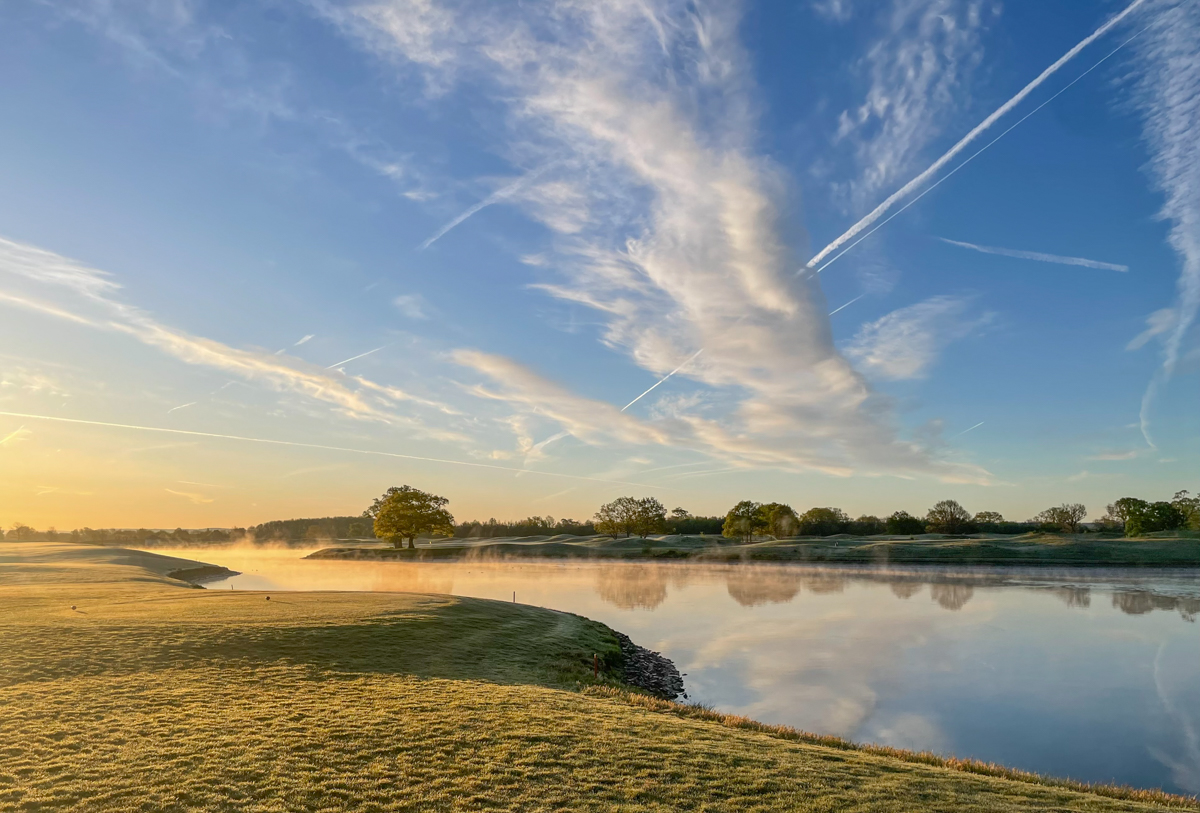
A glorious dawn
The third Oxon Big Day by Bike began at the Plain roundabout in Oxford city at 4am on Saturday 25th April 2026. The local bar was just locking up; the flashing lights of electric scooters illuminated the otherwise deserted roads. I was the first to arrive, quickly followed by Ben Sheldon, Max Buckley and then Thomas Miller. We cycled east and were soon passing through Elsfield, where the mournful wail of a Peacock rang out. Keen as we were to start recording birds, even we did not stoop so low as to tick Indian Peafowl. Instead, bird#1 was, as expected, a singing European Robin at 04:15.
We crossed through the Oxfordshire countryside in sub-zero temperatures as we headed out towards the Chilterns. Mist was glowing white in the lower areas, and the stars were shining above. It was a beautiful ride and such a contrast to the pouring rain of 2024. That rain prevented us from seeing or hearing Tawny Owl, so a movement of wings and the distinctive shape of a Tawny Owl leaving a tree on the road between Stanton St John and Worminghall brought a cheer of success from the group. Bird #2.
Our first site was about halfway to the Chilterns, we arrived on time as the sky began to lighten. There was a hard ground frost, it was 0 degrees. Despite my gloves, my fingers were already too cold to manage unclipping my helmet, so I asked Max to help, but he was as incapacitated as I was. We left our bikes and began birding, the pre-dawn song of Blackcaps, Garden Warblers, and Common and Lesser Whitethroats building up as the light levels increased. Within half an hour, we were bathed in a glorious frozen mixture of frost, mist and sunlight:


Cyclists are obsessed with energy conservation. It is all too easy to run out of fuel and suffer terribly on long rides. Even cycling at the front of a group expends much more energy than sheltering behind another rider. Max, the youngest member of the group and an elite runner, was particularly keen. Max ran around checking bushes and paths as our species count continued. I asked Ben and Thomas if Max had ever cycled over 150km in a day before? Would this early morning exertion cost him later in the day as fatigue set in?
Important key species seen at the first site were Little Owl and Grey Partridge, neither of which we saw elsewhere. Having racked up 45 species or so, we returned to our bikes and headed towards Tetsworth on the first of many rough gravel tracks that would test the carbon wheels on my road bike. The village provided our first Collared Doves and House Sparrows and an early morning Common Swift.
Chiltern challenges
The major climb of the day awaited us as we headed up Aston Hill, serenaded by Common Firecrests, and onto the Chiltern escarpment. Cowlease Wood held many singing Redpolls, competing with more Common Firecrests, a singing Mistle Thrush, singing Stock Doves, a drumming Great Spotted Woodpecker and a calling Eurasian Nuthatch. Ben thought that he heard a Eurasian Treecreeper call and a few minutes later it was sharply picked out by Max in the upper branches of a beech tree. Frustratingly, a couple of Common Crossbill calls, only heard by Ben and Thomas, meant that we could not include that species on our team list. At least three members of the team need to see or hear a species for it to count.


Above, Ben changes a rear wheel puncture at Cowlease, fortunately the only mechanical issue we had during the day.
Our next site deepened our frustration, as we spent a long time waiting to see or hear Woodlark. Even worse, Max and I saw a flying Woodlark, but we were unable to blurt out sufficient directions to allow Ben and Thomas to get onto it, before it dropped down out of sight. Calling Green Woodpecker, a flyover Common Raven and a Eurasian Hobby overhead meant that although we had accumulated a decent number of woodland species, some target species had eluded us in the Chilterns. Striping off layers as the temperatures rose, we began the ride out to the Oxfordshire Downs, picking up a Eurasian Sparrowhawk and a Western House Martin on the way, both good Big Day birds when it is hot and sunny.
Arriving at the Downs at 11am, the sun burned down on us, but this was not the main threat to my vision. Max stripped down to his luminous high-viz cycling kit. Camouflage this was not, and in all likelihood, Max was visible from space. Trying not to look at him directly, simply to prevent damage to my retinas, I also began to have PTSD flashbacks of previous Oxon Big Days that were dominated by high pressure, heat and little wind. These are tough days to find birds and we failed to find any migrants on the Downs, though our list was boosted by Corn Bunting, European Stonechat and Meadow Pipit.

Above, Port Meadow birding (l-r: Max, Thomas and Ben)
It is much more pleasant being on a bike than in a car on a hot day. We left the Downs and cycled north towards Oxford, with Max picking up a Peregrine circling over North Moreton and a Sand Martin over Appleford, their sensory apparatus no doubt stunned by the intense light levels that he generated.
Another advantage of being on a bike is that there is much more chance of hearing and seeing flyover birds. Common Terns passed over Oxford’s Folly Bridge as we made our way to Thomas’s local patch of Port Meadow. In the planning phase, Thomas was clearly very keen to get a visit to his patch included in the route. We had resisted initially, as Port Meadow can get very busy on a nice Saturday afternoon. But news of a Greenshank on the floods made it a sensible decision to head through the city for a short detour. As well as the Common Greenshank, Thomas sharply picked out a Little Ringed Plover at enormous distance, using Ben’s incredible image-stabilised AT Balance ‘scope. The image stabilisation is so good that a tripod is not needed, ideal for carrying on the bikes and the ‘scope proved invaluable throughout the day. The bikes came into their own again as we waited at a traffic light on the Botley Road bridge on our journey out to Farmoor Reservoir. We heard a number of loud ringing whistles, I called out “Kingfisher!”, another one of those species that always seems to be tricky on a spring Big Day.
At Farmoor we met Tom Wickens, who had been scouting for us during the morning and was doing his own personal Big Day by bike. Tom ended the day with 111 species, an impressive achievement for a solo effort on a hot day, all by bike or on foot. A distant Little Gull and an even more distant Great Black-backed Gull were picked out using the ‘scope, and our first Common Reed Warbler and Eurasian Cuckoo were both heard singing.

Above, the 2026 team, (l-r: Tom Wickens, Max Buckley, Ben Sheldon and Thomas Miller)

The ride from Farmoor to Blenheim was boosted by a flyover Cattle Egret near Bladon, plus a stop to buy more water in Woodstock, as the heat of the afternoon increased. Arriving at Blenheim at 5:30pm, it was not as crowded as we had feared. Thomas picked up a pair of Red-crested Pochard and Ben, using the ‘scope again, found the world’s most distant identifiable Mandarin.

In 2024, we arrived on Otmoor with 100 species under our belt and added 18 species. This year we left Blenheim for Otmoor on a total of 96 species, so we knew we were behind the birding pace. Unlike Max, whose early morning running did not affect his cycling fitness as he kept up the cycling pace from the front of the group all day. We even had a completely unnecessary, and potentially energy-sapping, sprint up the hill from Islip to Noke, tactical madness with 145km already in our legs. Max won. We got our breath back and rolled down the hill towards Otmoor.
It is always a pleasure to arrive on Otmoor. It was a beautiful, still spring evening, the heat of the day was fading and there were lots of new species to add. Quickly, Sedge and Cetti’s Warblers, Common Reed Bunting, Water Rail, Glossy Ibis, Western Marsh Harrier and booming Eurasian Bittern were all added to our day list. Ducks added included Eurasian Teal, Northern Shoveler and Common Pochard, but also another moment of frustration as Thomas saw the head of a Northern Pintail disappear down a channel, only for the bird to never reappear. This was the third species that was only partially seen or heard by the group as a whole and could not be added to the list. Waders seen included another Common Greenshank, to go with the breeding Common Redshanks, Common Snipe and Eurasian Curlew. A bonus was at least one Ruff, feeding on the mud on Big Otmoor. Less of a bonus was finding the long-staying Barnacle Goose of unknown origin, but as with previous years and previous teams it was added to the Oxon Big Day list.

The parakeet sleeps tonight
As darkness fell, Common Grasshopper Warblers began reeling and a Western Barn Owl began hunting over Greenaways, our 114th species of the day. We had reached a respectable total. There then followed two very contrasting birding experiences. Not having recorded Ring-necked Parakeet, we cycled back through the dark country lanes into Oxford city where Max knew of a Ring-necked Parakeet nest hole. Max had heard the birds in the nest hole making noises at night (we did not ask how or why), so we had the surreal experience of standing underneath a tree in complete darkness at night, waiting for a parakeet to call.

Above, photo from Ben Sheldon.
The longer it went on, the weirder it seemed and eventually we accepted that either the parakeets were sleeping very soundly or that they had fledged. Still on 114 species, we made our way to our final destination, seeing a Badger that scurried rapidly past Ben and I, en route. At 10:30pm the four of us ended our Oxon Big Day listening the beautiful song of a singing Common Nightingale, without doubt the best way to end a Big Day.
Our final total was 115 species, seen or heard by at least three members of a four-person team. A further three species (Common Crossbill, Woodlark and Northern Pintail) were only partially seen or heard by the whole group, which would have equalled our 2024 total of 118 species, the current Oxon Big Day record. 115 species is the third-highest Oxon Big Day total, which means that two of the top three Oxon Big Day totals have now been achieved by bike. In total we covered about 170km each on our bikes and at least 15km each on foot.
Expected species that we did not record on the day included Eurasian Jay, Northern Wheatear, Common Sandpiper and Eurasian Wigeon. Bird of the day was our last bird, the fabulous singing Common Nightingale.
A huge thank you to everyone who helped provide information both beforehand and on the day itself. Special thanks to Tom Wickens, Simon Myers, Adam Hartley, Gareth Casburn and Nick and Luke Marriner.
The eBird trip list is here: https://ebird.org/tripreport/505142 (nationally sensitive species will not appear in the species total displayed here).