I arrived at the Barrage de la Grand Dixence at 7:15am. The group of teenagers I was chaperoning had been up past 2am last night and would be asleep until mid-morning. It was time to try to find a Wallcreeper.

Barrage de la Grand Dixence
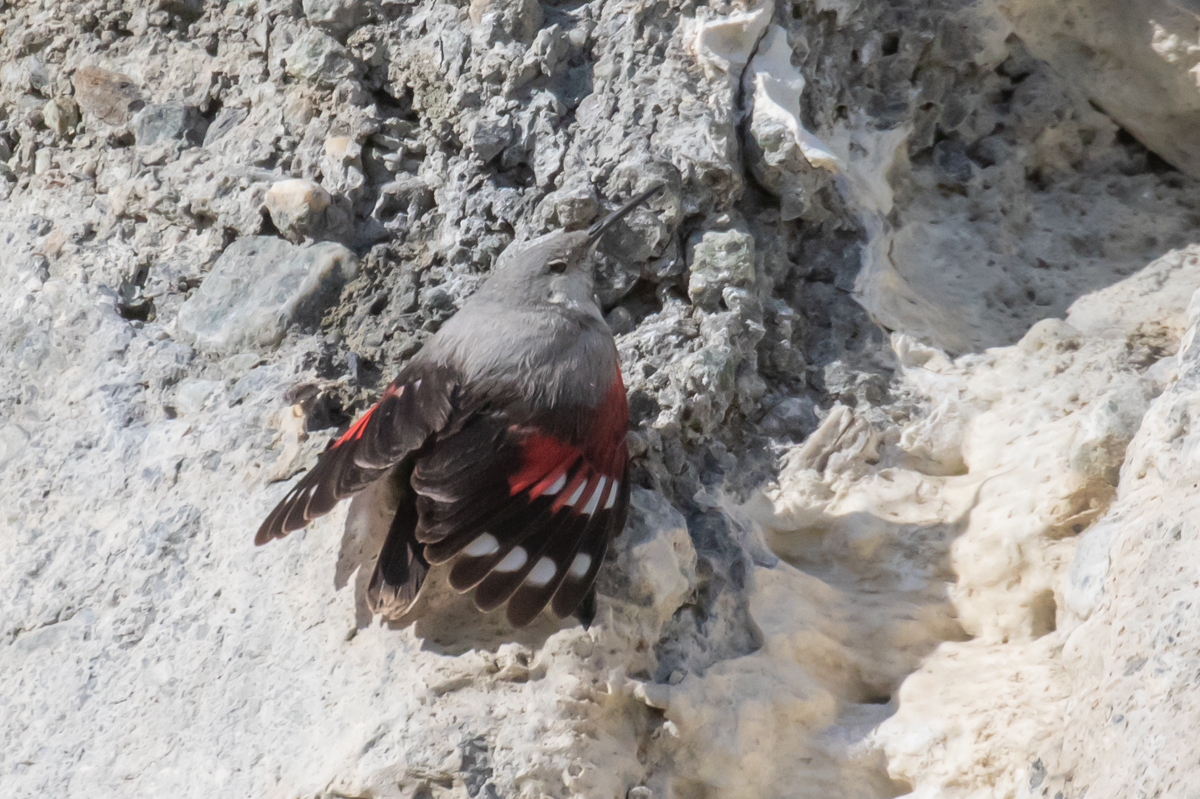
Wallcreeper is one of the best birds in the world, and for me, probably THE best. Only found on vertical cliffs in the highest mountains, this bird, in summer at least, is only seen surrounded by stunning mountain scenery. The bird itself is a delight. Superficially appearing grey and black, well camouflaged against a rock face, Wallcreepers flick open their wings as they move about their vertical habitat. The black wings have two large white spots on each primary, and each primary base and all the wing coverts are the colour of deepest crimson. The effect of this palette is sudden flashes of black, white and crimson, a stunning combination from this jaw-dropping jewel of the high mountains. But, as always with this species, first there was the task of getting into their high altitude breeding territory, and secondly, there was the challenge of actually finding one. Wallcreepers have large territories and are not straightforward to see.
The Barrage de la Grand Dixence is the world’s tallest dam, some 285m high, with the crest standing at 2,365m, high enough to give access to the birds of the high Alps. The easy way up is to take a cable car, but this does not start until 10am. There is also a winding access track that allows the authorities to drive vehicles up to the top of the dam; you can hike up this track anytime. Or, you can take the steep path, which runs pretty much directly up the side of the mountain, alongside the enormous dam wall, which holds back some 400 million cubic meters (approximately 10.6 billion gallons) of water. Best not to think about that. I took the steep path. It is a lung-busting climb, but it only takes about 20 minutes. The trees on the lower slopes held the ubiquitous Black Redstarts and singing Eurasian Blackcaps, Redpolls, Common Chiffchaffs, Common Linnets and a singing Lesser Whitethroat. I also noted a singing Dunnock. I was hoping that this would not be the only species of accentor recorded today.
Code Crimson
As the steep path flattened out it met the top of the access road, and I found myself just below the cable car top-station:

Top cable car station at the Barrage de la Grand Dixence
The view, back down to the car park and over the valley, was incredible. Even above my hyperventilation, I could hear a singing Alpine Accentor and a flash of white nearby drew my attention to a White-winged Snowfinch, feeding on the ground, it’s beak full with insects:

I did not consciously recall seeing a movement in my peripheral vision, but something made me look up, away from the Snowfinch. There were two grey and black triangles on the wall above me:

As I became aware of them, I simultaneously became aware of pulses of black, white and crimson as the birds moved. There were two Wallcreepers feeding on the concrete wall above me. Holy Jesus!
This was beyond my wildest dreams. I had found only one report of Wallcreeper at this site this month, though a pair had been regularly reported in previous breeding seasons, once even nesting in the wall of the hotel at the bottom of the dam. I was far from certain that I would see them today. Yet, here they were, almost immediately and at close range and in perfect light.

Moving slightly closer to the wall, I could see that the regular wing-flicking created some pretty funky shapes:

The Wallcreepers moved with short hops, somehow gaining traction on what appeared to be a near-flat, vertical wall. Occasionally, they took jumps to traverse the rock face. Below, both legs are visible as this Wallcreeper ran across the rockface, using its wings to help propel the movement:

One bird made a short flight by literally hopping from the rockface, its legs in the process of being retracted, leaving its rapidly shrinking shadow on the rock wall:

The French refer to Wallcreeper as the “butterfly bird” of the mountains. The rounded wings with black-and-white flight feathers are immediately reminiscent of Eurasian Hoopoe. But when seen in flight, and unlike Eurasian Hoopoes, Wallcreepers appear very short-tailed, creating a diagnostic flight image:

Without warning, one Wallcreeper left the wall and flew over my head and rapidly away, staying close to the cliffs to the north. The Birding Gods then looked down at me and granted me some fortune. The remaining Wallcreeper dropped down to the base of the wall, even closer to me and now at head height. It then began to work its way up the rock face, Treecreeper-style. This bird gave fabulous views, revealing the crimson at the base of the wings at close range, the soul of any Wallcreeper encounter.
Below: when stationary, the crimson primary bases and wing coverts create two bright bars of colour on the black closed wing:

As the wings flick open, the extent of the crimson primary bases becomes apparent. The double white wing spots on the outer four primaries flash. The effect is astonishing!


Having moved up the wall a short distance, the female Wallcreeper then took the same flight path as its mate, over my head and away to the north, rounding a corner of the cliff and flying out of sight. The whole encounter lasted a little over two minutes, but I was left reeling from the adrenaline of the experience. Realising that I had been incredibly lucky to come across two Wallcreepers at close range so quickly, I took the path that runs south along the west side of the reservoir to find some more birds.

Lac des Dix and the pathway running along the west shore of the reservoir.
Taking the path around the reservoir involved going through a number of tunnels. This was much easier on my return journey, by which time the tunnel lights had been turned on! On my outward walk, I passed through these tunnels in darkness.

Emerging from the tunnels, the landscape opened up into a beautiful panorama:


Alpine Marmots (above) were calling, and Water Pipit and Northern Wheatear were common:

Alpine Accentors could be found on the scree slopes between the tunnels, some giving great views. This is one of my favourite species, as they are full of plumage features. Check out the well-marked undertail coverts; the rusty flanks; the all-black wing coverts, tipped with white; the black-and-white spotted throat; and the yellow base to the bill:


Above, White-winged Snowfinch. I had incredible views of this species and Alpine Accentor on the walkway on top of the dam.

Looking down on the Barrage de la Grand Dixence.
Returning to the dam, my last scan of the cliffs to the north revealed two short-tailed birds flapping their way up to a higher altitude. It was the Wallcreeper pair again! They were extremely distant, but as I watched, the female dropped down to feed on a cliff, whilst the black-throated male perched on a wire near the clifftops. This was a rather surreal way to end my Wallcreeper experience. Wallcreeper must be one of the least likely species to see perched on a wire somewhere. A morning never to be forgotten.

Wirecreeper!